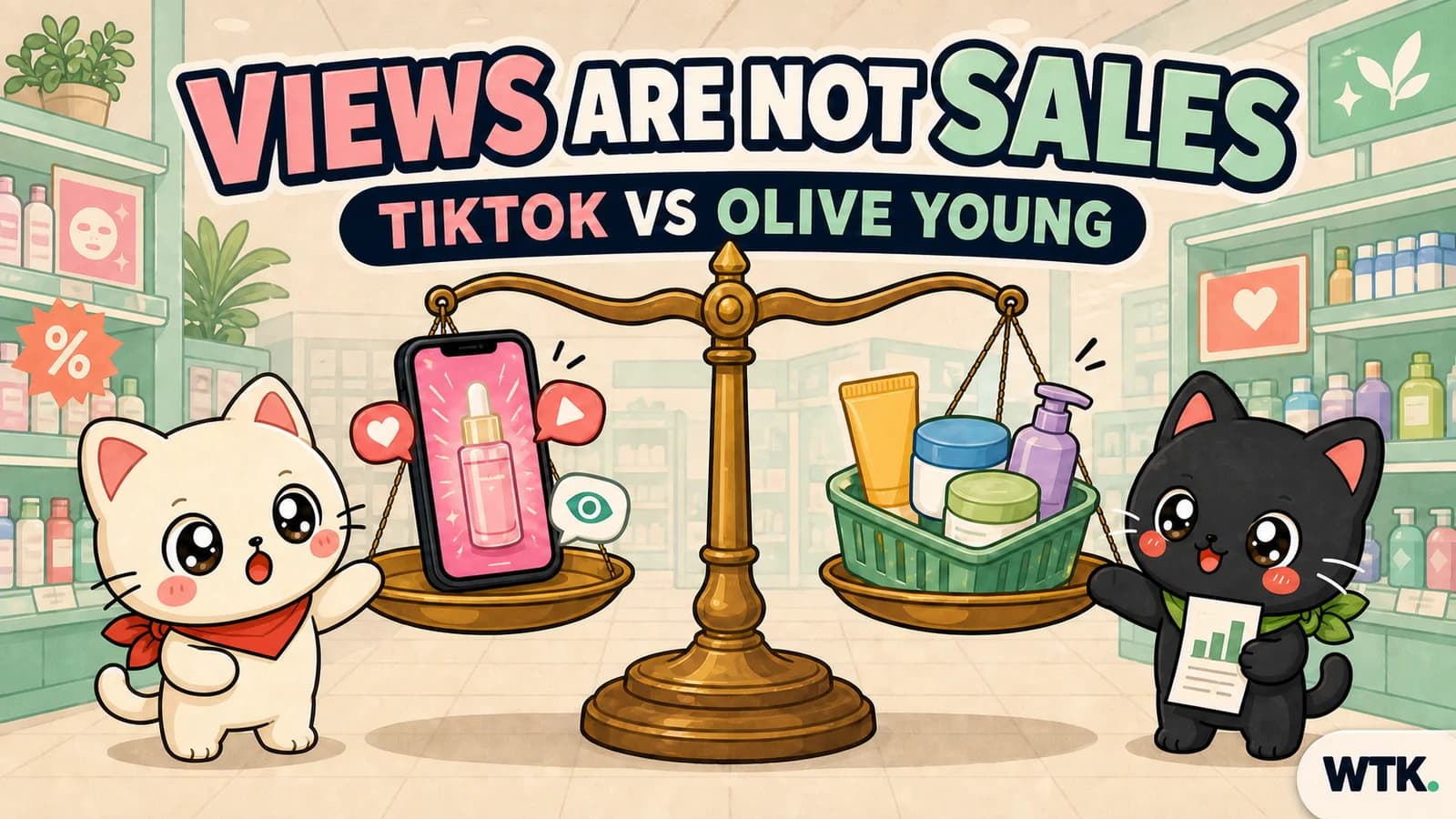
Your TikTok feed says every person in Seoul is peeling off the same pink mask. You enter an Olive Young in Korea and the busiest shelf contains a barrier cream, a sunscreen stick, and three kinds of hair treatment.
Who is showing you the “real” K-beauty?
Both—and neither. TikTok measures attention inside a personalized video feed. Olive Young's rankings measure purchases inside one powerful Korean retailer. Confusing those signals is how a fun beauty discovery becomes a suitcase full of products you never needed.
TikTok and Olive Young answer different questions
TikTok asks: What beauty video will keep this person watching?
Olive Young asks: What products are customers buying through this retailer right now?
That sounds obvious, but online K-beauty conversations often treat views and sales as if they were the same scoreboard. They are not.
TikTok says its For You recommendations consider signals including viewing behavior, likes, shares, comments, follows, captions, sounds, and hashtags. The feed is personal. Two people searching “Korean skincare” can quickly receive different versions of the category: acne transformations for one, lip tints for another, and elaborate nighttime routines for a third.
Olive Young's Global best-seller page says it is updated daily and based on online and offline sales data from Olive Young in Korea. That makes it a valuable view of Korean mass beauty retail—something a creator's bathroom shelf cannot provide.
But a sale ranking is not a national census. It is shaped by what the retailer carries, what is in stock, which item has a discount or exclusive set, what season Korea is experiencing, and which campaign customers see inside the store.
| Signal | What it can tell you | What it cannot prove |
|---|---|---|
| TikTok views | A video or product attracted attention | That viewers purchased or repurchased it |
| Search volume | People became curious about a name or ingredient | That the product suits their skin |
| Olive Young daily ranking | An item is selling through Olive Young in Korea | That every Korean uses it |
| Olive Young award badge | The product performed strongly in that retailer's system | That it is the best option for every budget or concern |
| Sold-out shelf | Demand may be high at that location and moment | Whether demand came from locals, tourists, a discount, or limited stock |
| Creator review | One person's experience and demonstration | A controlled test or universal result |
The smartest question is therefore not “Which list is true?” It is “What behavior created this list?”
Why some K-beauty products are built for TikTok
A short beauty video needs a visible event.
A cream that quietly reduces dryness over several weeks is difficult to dramatize. A bubbling mask, stretchy texture, color-changing lip stain, peel-off film, foaming cleanser, or visibly soaked toner pad gives the camera something to do immediately.
TikTok does not secretly command creators to choose spectacular textures. The incentive emerges naturally from the format. Watch time and interaction help recommendation systems understand what viewers enjoy, and a product with a clear beginning, reveal, and reaction makes an efficient story.
Viral K-beauty therefore tends to reward:
- visual transformation: before-and-after contrast, even when lighting also changes
- sensory surprise: prickling, cooling, stretching, bubbling, peeling, or glossy texture
- one memorable hook: “salmon DNA,” “liquid microneedling,” or “glass skin in one night”
- recognizable packaging: a product viewers can identify during a fast scroll
- easy demonstration: one swipe, one pad, one mask, one satisfying reveal
- international availability: products creators and viewers can actually order
None of those qualities makes a product bad. They make it communicable.
Our guide to PDRN skincare shows how a technical ingredient becomes an irresistible headline. Our article on spicule skincare and Reedle Shot explains why an immediate prickly sensation and numbered strength system travel so well online. Both trends also became meaningful in Korean retail. Viral and locally popular are allowed to overlap.
The problem begins when the most filmable benefit becomes the entire product claim. A dramatic texture does not prove long-term results. Tingling does not measure efficacy. A single glowing application under a ring light does not establish that a formula improved someone's skin.
Why Olive Young looks more practical—and more complicated
Walk through a Korean Olive Young and K-beauty expands beyond the export image of serums and sheet masks.
There are cleansing oils, acne patches, cotton pads, scalp tonics, hair-loss shampoos, body sprays, makeup fixers, false-lash tools, contact-lens accessories, protein drinks, oral-care products, and rows of sunscreen formats. Many are ordinary repeat purchases rather than products designed to produce one astonishing video.
Current Korean retail trends also respond quickly to weather and daily routine. Olive Young's June 2026 sale analysis described “survival beauty” (saengjon byuti, 생존 뷰티): consumers bought products for early heat, sweat, odor, sun reapplication, and makeup durability. The retailer reported growing interest in sun powders and a practice it called sun layering, using different formats for the face, body, hair, and reapplication.
That is very Korean summer content, but it may not dominate an overseas winter feed. Korea's climate, commute, school and office routines, and product launch calendar create needs that international viewers do not share at the same moment.
Olive Young has also promoted broader themes such as:
- seullou-eijing (슬로우에이징, slow aging): gradual, preventive care rather than promising to erase age
- seongbun byuti (성분 뷰티, ingredient beauty): shopping by PDRN, peptides, niacinamide, or another highlighted ingredient
- seukinkeorieong meikeueop (스킨케어링 메이크업, skincare-infused makeup): color products marketed with care benefits
- head-to-toe care: treating scalp, hair, body, and hands with the category detail once reserved for facial skincare
- wellness: massage tools, relaxation products, supplements, and food sharing space with cosmetics
These labels are not neutral discoveries made by a laboratory. They are also retail curation: Olive Young identifies behavior, gives it a memorable name, groups products around it, and promotes the category. A retailer can observe a trend and help create the trend at the same time.
Rankings are equally dynamic. A product can climb because it has a 1+1 bundle (won-peulleoseu-won, 원플러스원), a gift-with-purchase set, an Ol-yeong seil (올영세일, Olive Young sale) discount, an award label, or better stock availability. Those are real purchases, but the chart still needs context.
There is no single shelf called “what Koreans use”
Olive Young is enormously influential, but Korea has more than one beauty economy.
A dermatologist-recommended moisturizer may sell through pharmacies or clinics. A budget mini may become famous at Daiso. A family-sized lotion may move through hypermarkets or Coupang. Luxury cushions can be stronger in department stores. Salon hair products, professional aesthetic brands, television home-shopping sets, brand websites, and local road shops each see a different customer.
Even inside Olive Young, several audiences overlap:
- Korean customers making routine purchases
- trend hunters trying a new launch
- international tourists following saved social-media lists
- gift shoppers attracted to exclusive bundles
- online customers responding to delivery and sale events
A top-ranking product may be genuinely popular with Koreans and heavily purchased by tourists. Those statements do not cancel each other.
The phrase “Koreans actually use this” should therefore trigger the same skepticism as “TikTok made this sell out.” Which Koreans? Which store? Which week? Which category? Was it full price? Was it a launch? Was it a repurchase?
The same caution applies to Korean beauty language. The slang hwajalmuk—a day when makeup applies unusually well describes a result shaped by skin condition, preparation, formula, weather, and technique. One viral foundation cannot guarantee that result for everyone.
Korean rankings and global feeds move at different speeds
A product can travel in either direction.
Sometimes it proves itself in Korean retail, receives awards and reviews, reaches export distributors, and only later finds the right overseas creator. International audiences then experience an old Korean steady seller as a brand-new discovery.
Sometimes a Korean brand designs a campaign for global social media first. Overseas demand rises, tourists look for the product in Seoul, and Korean awareness follows. The export trend returns home carrying foreign validation.
Sometimes the formulas or assortments do not match. Olive Young Korea, Olive Young Global, a future overseas store, and a local Western retailer operate under different shipping, labeling, pricing, and regulatory conditions. A product name can remain similar while its available shades, package size, set composition, or formula changes.
Sunscreen is the clearest example. The United States regulates sunscreen as an over-the-counter drug, while regulatory systems elsewhere can permit different UV filters and product routes. In June 2026, the FDA added bemotrizinol as the first new permitted U.S. sunscreen active ingredient in decades. That was a major change, but it did not instantly make every Korean sunscreen formula available unchanged in every American channel.
Always compare the exact ingredient list and package sold in your country. “The Korean version” and “the viral version” are not reliable regulatory categories.
How to use both lists without buying the hype
TikTok is excellent for discovery. Olive Young is useful for checking Korean retail momentum. Neither should make the final decision alone.
1. Start with a need, not a product
Write one sentence: “I need a fragrance-free moisturizer for dry, easily irritated skin,” or “I need a lip tint that leaves a stain but does not feel sticky.”
If the viral product cannot answer that sentence, its popularity is irrelevant.
2. Check the category ranking
An overall Olive Young chart can place a lipstick beside a protein shake and a shampoo. Open the skincare, sunscreen, lip, cleansing, or hair category that matches your goal. Check whether the ranking is daily, weekly, monthly, or tied to a sale.
3. Look for the promotion behind the number
Ask whether the item is discounted, doubled, bundled with minis, or carrying an exclusive gift. A promotion does not make the rank fake; it tells you why this moment may not represent ordinary full-price demand.
4. Separate the product from the content
Check whether the creator received payment, commission, free products, or a shopping link when that information is available. Then ignore the transformation montage and write down the testable points: texture, finish, fragrance, amount, wear time, directions, and irritation.
5. Compare the exact version
Match the full name, size, shade, ingredient list, manufacturer, and market. Do not assume every pink bottle from the same line contains the same formula.
6. Read several kinds of review
Combine:
- one demonstration for texture and application
- recent low-star reviews for recurring problems
- long-term reviews for durability or irritation
- Korean retail reviews for local use context
- qualified medical guidance when the claim concerns a skin condition
Review counts are not clinical evidence, but patterns can reveal leaking pumps, fragrance complaints, pilling, shade mismatch, or unrealistic directions.
7. Buy one experiment
Do not build a ten-step routine from ten separate viral videos. Patch-test when appropriate, introduce one product at a time, and stop if persistent burning, swelling, or a rash develops. The quietest K-beauty habit is also the most useful: repurchase what your own skin already tolerates.
The real difference is attention versus routine
TikTok shows K-beauty at the moment it becomes a story. Olive Young shows K-beauty at the moment it enters a shopping basket.
One favors the surprising. The other often favors the repeatable—but is still shaped by promotion, assortment, tourists, weather, and retail strategy.
Use TikTok to discover a question: “Why is everyone talking about this?” Use Olive Young to ask a second question: “Is anyone buying it in Korea, in the category and season I care about?” Then use ingredients, directions, evidence, price, and your own skin to make the decision.
The “real K-beauty” is not hiding in one ranking. It is the entire path from scroll, to shelf, to bathroom, to the one signal marketers cannot manufacture forever: repurchase.
Sources
- Olive Young Global — Daily best sellers based on Korean online and offline sales
- CJ Olive Young — 2026 K-beauty and wellness trend report
- CJ Olive Young — June 2026 sale data and “survival beauty”
- CJ Newsroom — 116 K-beauty brands exceeded KRW 10 billion in Olive Young sales in 2025
- TikTok Newsroom — How the For You recommendation system works
- U.S. FDA — Sunscreens are regulated as over-the-counter drugs in the United States
- U.S. FDA — Bemotrizinol added as a permitted sunscreen active ingredient in 2026