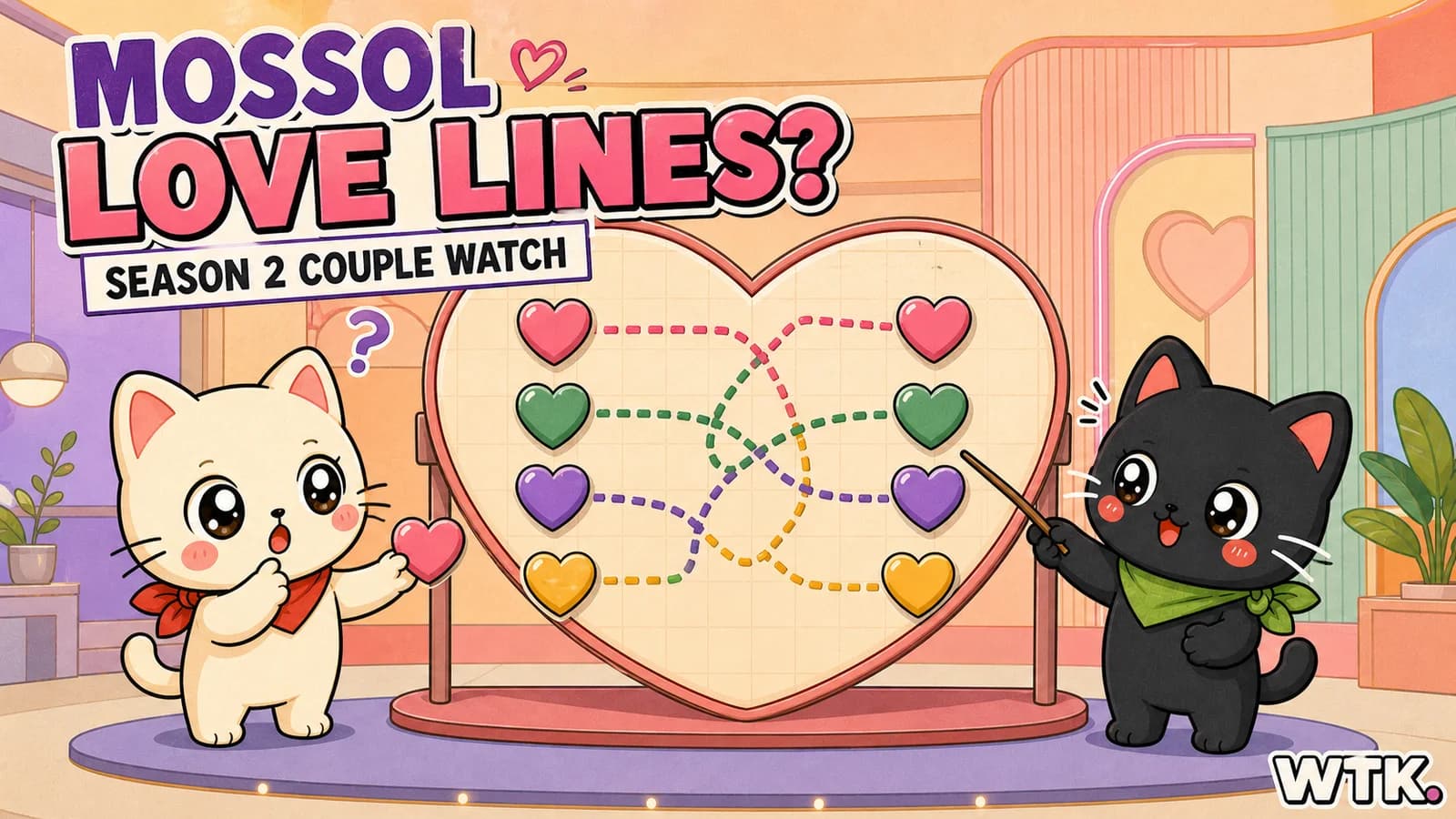
Netflix's Better Late Than Single is back for Season 2, and Korea's least experienced daters have somehow created its most complicated relationship chart. Through episode 6, the obvious couples are wobbling, surprise choices are multiplying, and the panelists are once again shouting advice at a screen that cannot hear them.
The Korean title, Motae Solojiman Yeonaeneun Hago Sipeo (모태솔로지만 연애는 하고 싶어), translates more directly as “I Have Been Single Since Birth, but I Want to Date.” That first phrase—motae solo (모태솔로), usually shortened to mossol (모쏠)—is the cultural key to the entire show.
Spoiler line: This article discusses romantic choices through Season 2, episode 6, released on July 14, 2026. The finale is scheduled for July 28, so these are predictions, not leaked results.
What does motae solo—and mossol—actually mean?
Motae solo is a wonderfully dramatic Korean hybrid:
- motae (모태, 母胎) literally means a mother's womb
- solo (솔로) is the English loanword “solo”
- mossol (모솔 or 모쏠) is the quick, casual abbreviation
Put together, it means someone who has been single “since the womb”: a person who has never officially dated. The phrase is exaggerated on purpose. Nobody is checking whether you exchanged crayons with a kindergarten crush.
It is also more specific than simply being single. A person who dated last year but is alone today is solo; a person who has never had a boyfriend or girlfriend may call themselves motae solo. Friends might announce a successful first relationship as mossol talchul (모쏠 탈출), “escaping mossol status.”
That does not automatically mean the person is shy, unattractive, socially isolated, or uninterested in romance. It does not reliably tell you anything about sexual experience either. It only describes the absence of an acknowledged romantic relationship. Work, study, family expectations, limited opportunities, anxiety, or simply not meeting the right person can all lead to the same label.
Most importantly, mossol is not a clean Korean equivalent of “incel.” The English term often carries an online ideology and a sense of grievance toward others. Motae solo can be self-deprecating, affectionate, teasing, or occasionally insulting depending on tone, but it does not contain that ideology by definition.
Why Better Late Than Single makes mossol life entertaining
Most dating shows begin with contestants who already know the grammar of television romance: hold eye contact, create a little jealousy, ask for a private chat, and reveal just enough to survive the edit. Better Late Than Single removes that fluency.
The contestants may have impressive jobs, strong opinions, and full adult lives, yet a simple “Can we talk?” can feel like a final exam. The entertainment comes from the gap between enormous feelings and very limited practice.
Season 2 premiered on July 7 after more than 17,000 applications, according to cast coverage. Its original group ranges from a game developer who spent years living at work to a shy homebody who struggles with eye contact and an anime fan more comfortable with fictional characters than real-life dates. Later “game changers” enter to disturb the early pairings—the dating-show role Koreans often call a megi (메기, catfish).
The returning hosts—Seo In-guk, Kang Han-na, Lee Eun-ji, and Car, the Garden—function like experienced friends watching a group chat go wrong in real time. Producer Kim Noh-eun said the women would have a stronger presence this season, while producer Won Seung-jae described Season 2 as closer to a full dating show than Season 1's gentler “educational” feeling. By episode 6, that promise has been fulfilled.
Season 2 couple predictions after episode 6
Here is the honest answer: no couple is safe. That is also why the show is fun. Instead of pretending the edit has already revealed the ending, these rankings measure three things: mutual interest, repeated choices, and whether the pair can survive one direct conversation.
| Pair to watch | Current read | Why it could work | Biggest danger |
|---|---|---|---|
| Choi Hyun-seo × Choi Hyuk-joon | Strong history, falling confidence | They formed the clearest early connection and seemed comfortable together | Hyun-seo initially held back, while Hyuk-joon began reconsidering the match |
| Han Su-ji × Yoon Jung-yun | Real spark, major detour | Jung-yun's interest and their chemistry made them look like a natural line | Su-ji chose Hyuk-joon for the special date instead |
| Choi Hyuk-joon × An Jeong-eun | Wildcard | Hyuk-joon's episode 6 choice creates a new opportunity away from expectations | The choice arrived without a long romantic buildup visible to viewers |
Prediction 1: Hyun-seo and Hyuk-joon still have the best story
Hyun-seo and Hyuk-joon were the easiest early couple to circle in red. Hyuk-joon focused on her through the first four episodes, and their quieter temperaments appeared compatible. But “we are both quiet” is not the same thing as “we communicate well.”
Hyun-seo's hesitation left Hyuk-joon uncertain, and his tendency to evaluate small points of compatibility made the line suddenly fragile. Her later attempt to express herself may repair it, but the pair now needs an actual conversation rather than another round of mind reading.
WTK prediction: best chance of delivering the season's emotional reconciliation, but no longer the safest final couple.
Prediction 2: Su-ji and Jung-yun have chemistry, not security
Su-ji's arrival changed the house immediately. She became one of the most sought-after participants, and viewers naturally connected her with Jung-yun. Then episode 6 handed her a special date choice—and she selected Hyuk-joon.
That does not erase her earlier connection with Jung-yun. A dating show is designed to test curiosity as well as loyalty, especially before anyone has promised exclusivity. But it does mean Jung-yun can no longer assume that patience will be rewarded.
WTK prediction: the strongest candidate for a dramatic return after a jealousy arc, provided Jung-yun speaks instead of silently withdrawing.
Prediction 3: Jeong-eun is the wildcard the edit hid in plain sight
Hyuk-joon was expected to choose Hyun-seo. Su-ji had just chosen Hyuk-joon. He instead selected Jeong-eun, surprising both the house and the panel.
There are two possible readings. It may be a genuine late-blooming interest that the edit kept quiet for maximum surprise. Or it may be a low-pressure choice made by someone who wanted space from two increasingly intense storylines. The date itself will decide which.
WTK prediction: less likely to become the final couple, but most likely to rearrange everyone else's decisions.
The Korean dating words hidden inside the show
Watching the series becomes easier once you know the stages Korean speakers use to label romance:
- Hogam (호감) — a favorable feeling or initial attraction.
- Sseom (썸) — the undefined “something” before official dating.
- Gobaek (고백) — a direct confession asking to begin a relationship.
- Yeonae (연애) — an acknowledged romantic relationship.
- Mossol talchul (모쏠 탈출) — finally leaving lifelong-single status.
This sequence explains why tiny choices feel so serious. In some Western dating contexts, several dates may happen before anyone defines the relationship. Korean popular culture often treats gobaek as the boundary: before the confession, you may only be in a sseom; after both people agree, day one of the relationship begins.
That makes a first relationship feel measurable. Couples may count their first day and celebrate the famous 100-day milestone. The show is therefore not merely asking, “Who do you find attractive?” It is asking contestants to cross a named social boundary they have never crossed before.
The awkward pacing also has something in common with why Korean dramas often release in weekly episode pairs: one episode creates a misunderstanding, and the next gives just enough time for a conversation—or a more impressive misunderstanding. Unlike a scripted series adapted from a proven story, however, these contestants cannot rely on the structure that helps webtoon-based K-dramas manage their romance arcs.
Is calling someone mossol rude?
It depends on who says it, how they say it, and whether the person chose the label.
Among close friends, “Are you still mossol?” can be ordinary teasing. Someone may use the word about themselves in a dating profile or joke, just as the show's cast does. But using it to diagnose a stranger's personality—or treating lack of experience as evidence that something is wrong with them—can be humiliating.
A useful rule for foreign visitors is simple: understand the word before using it. If a friend calls themselves motae solo, you can follow their tone. Do not introduce a quiet coworker at dinner as “our company mossol.” Korean group dinners already come with enough social rules; our guide to Korean drinking culture explains why adding a surprise dating résumé would not improve the evening.
Season 2 works when it remembers the same rule. Being inexperienced is the premise, not the punch line. The satisfying moments are not simply makeovers or successful matches; they are the moments when someone asks clearly, answers honestly, or survives rejection without deciding they are unlovable.
The final couples may change before July 28. The meaning of motae solo will not: it describes a dating history, not a person's value. And if this cast proves anything, zero experience can still produce maximum plot.
Sources
- Netflix — Better Late Than Single Season 2 trailer and producer comments
- Netflix Media Center — Better Late Than Single
- Korea JoongAng Daily — Older, but not wiser in love, on Season 2
- Marie Claire — Better Late Than Single Season 2 cast guide
- Filmibeat — Episodes 5–6 choices and ending recap
- Jeju National University — Linguistic study listing 모쏠 as an abbreviation of 모태솔로