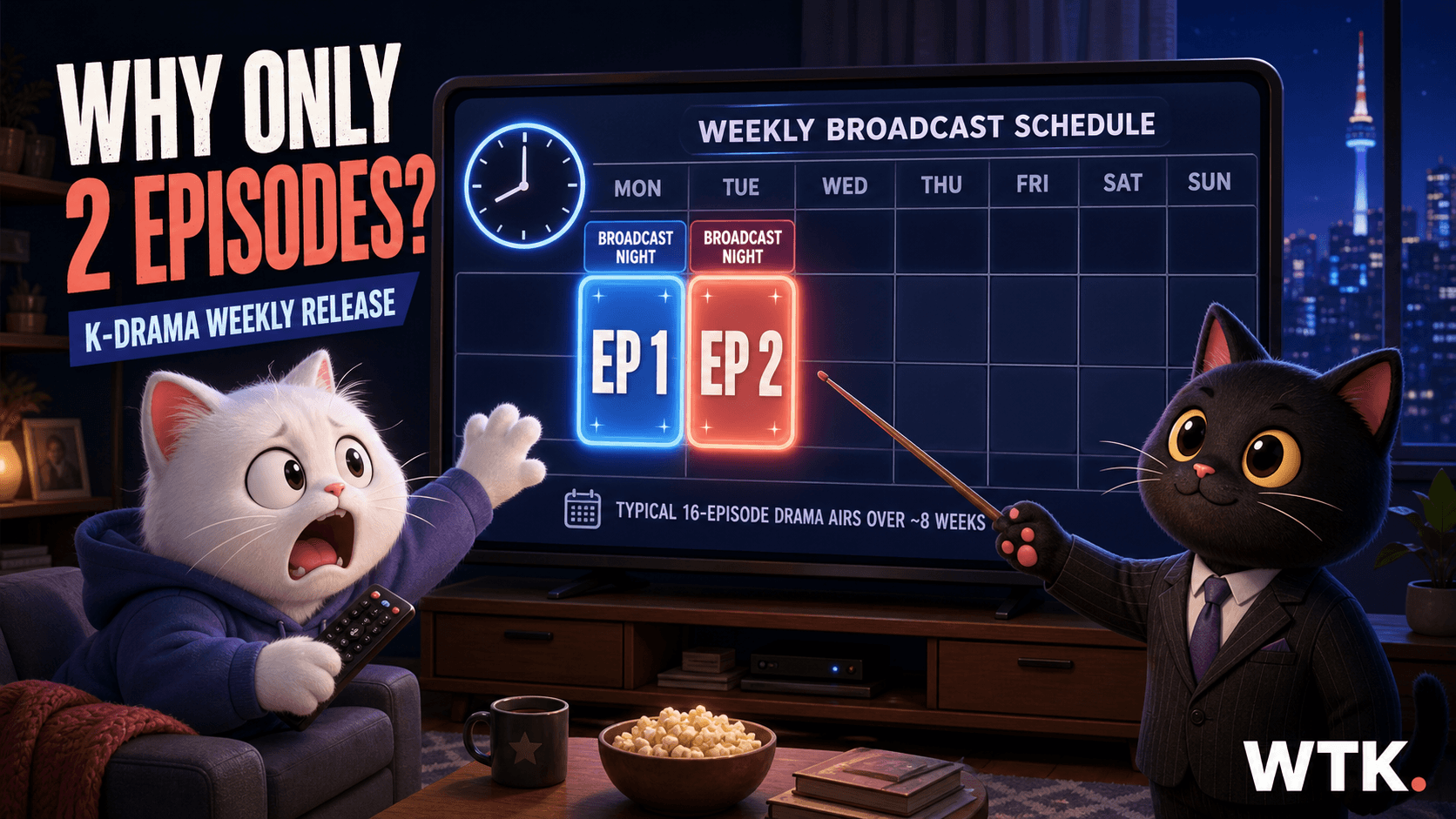
Most K-dramas release two episodes a week because they are Korean television shows first and streaming titles second. International platforms usually follow the broadcaster's fixed two-night schedule.
In July 2026, Agent Kim Reactivated (김부장) — So Ji-sub's SBS action drama — averaged 18.8% nationwide for its third episode and reached a momentary peak of 23%, according to Nielsen Korea data reported by Newsis. It also became Netflix's most-watched non-English TV title for the week, with 10.5 million views and No. 1 rankings in eleven countries, according to the Korea JoongAng Daily. If you have ever groaned at one of its cliffhangers, this is the system behind the wait — and why it is not going away.
The Korean title carries another layer that the English title leaves behind. Kim Bujang sounds like an ordinary senior department manager before it sounds like an action hero. Our K-Life guide explains what bujang means in Korea's corporate hierarchy.
Two episodes a week is the broadcast grid at work
Most "Netflix K-dramas" aren't made by Netflix. They're licensed from Korean broadcasters — SBS, MBC, KBS, tvN, JTBC — and stream right after each episode airs on Korean television. So the release schedule you're feeling is pyeonseong (편성, the broadcast grid): Korean networks slot dramas into fixed twin-night blocks — Monday–Tuesday, Wednesday–Thursday, Friday–Saturday, or the weekend pair.
A standard 16-episode drama occupies one slot for eight weeks, one episode per night, two nights per week, landing on streaming shortly after the roughly 10 p.m. KST broadcast. When international viewers wait for Friday, they're really waiting for prime time in Seoul.
There's an even blunter reason a full-season drop is often off the table: many broadcast dramas are still being filmed while they air. Korean production famously runs close to live — scripts can arrive on set days before broadcast, and writers adjust story beats to audience reaction week by week. Unless a show is fully pre-produced — sajeon jejak (사전제작) — the later episodes simply don't exist yet when episode one goes out.
Sicheongnyul: ratings are still the scoreboard
Why not just hand streaming the whole season? Because in Korea, sicheongnyul (시청률, TV ratings) are still the industry's scoreboard. Overnight numbers set ad prices, decide a network's bragging rights, and function as a public report card for writers and actors — they make next-morning headlines the way box-office numbers do elsewhere. Agent Kim Reactivated's third episode averaged 18.8% nationwide and briefly peaked at 23%, making it the highest-rated miniseries of 2026 at that point.
A full-season drop would scatter that audience. A weekly broadcast concentrates it into two appointment nights, keeps the show in the news cycle for two months, and lets word of mouth compound between episodes.
Bonbang-sasu: watching live is fan labor
The audience holds up its end of the deal. Bonbang-sasu (본방사수, "defending the live broadcast") is the fan practice of deliberately watching a show live on TV — not on a streaming app later — because live viewership is what the ratings meters count. Fans of an actor treat it as tribute; casual viewers join so the next day's group chat doesn't spoil them.
It's the same real-time, all-together-now instinct that makes K-pop ticketing a competitive sport: in Korean fan culture, showing up at the exact same moment as everyone else is the point. A hit drama becomes a twice-weekly national appointment, complete with live chatter, instant memes, and next-morning think pieces.
The binge divide
Netflix trained the world on morabogi (몰아보기, binge-watching), and the collision shows in the charts. Weekly releases can feel natural to viewers accustomed to Korean broadcast schedules and frustrating to audiences trained to expect a full season at once. Country rankings can show where a series is gaining momentum, but public chart data alone cannot tell us why viewers stay or move on.
The quick way to know what you're getting:
- Netflix-produced titles (think Squid Game) — more likely to use a full-season or split-season release, although the schedule varies by title.
- Broadcast simulcasts (most romances, office dramas, and action series) — two new episodes a week, same nights every week, for about eight weeks.
How to live with the wait
You can't speed up Seoul's prime time, but you can get on its rhythm. Learn your show's two fixed nights and treat them as appointment TV. Spend the in-between days the way Korean viewers do — theory threads, recaps, rewatching the cliffhanger — because the wait is where fandom actually happens. Or do what plenty of Koreans also do: save the finale week, then binge the whole run at once.
The two-a-week schedule isn't Netflix being stingy. It's the heartbeat of Korean television — a country where everyday life runs on shared, synchronized routines — exported to the world in real time. Sync up once, and cliffhanger Friday stops being a bug. It becomes the best night of the week.
How to tell which schedule your drama actually follows
“Two episodes a week” is a useful pattern, not a promise. Korean television schedules can shift for holidays, sports broadcasts, special programming, production delays, or a broadcaster’s own strategy. Streaming services may label episodes differently across regions or release both weekly episodes at once after the Korean broadcast. The official Korean broadcaster or platform title page is therefore more reliable than an old fan-made calendar.
Before planning a watch party, check four details:
- Korean broadcast days: a Saturday–Sunday drama and a Friday–Saturday drama both deliver two episodes, but the international upload can cross a date boundary.
- Korean airtime: convert from KST and account for daylight-saving changes in your own country.
- Platform wording: “weekly,” “new episode,” and a displayed episode count do not always reveal whether subtitles arrive simultaneously.
- Preemption notices: the network’s current schedule overrides the pattern shown at premiere.
This also explains why episode discussions can look out of sync. Korean viewers may be reacting to a live broadcast while another region is still waiting for localization. Treat spoiler windows as a community agreement rather than evidence that one platform made an error. For the production side of another common format choice, see why so many K-dramas begin as webtoons.
Build a release calendar from primary signals
Start with the Korean broadcaster or platform title page, not an automatically generated episode countdown. Record the Korean broadcast days and time, the viewer's time zone, the local streaming service, and whether subtitles arrive simultaneously. Mark sports, holidays, and special broadcasts as possible preemption points, then update the calendar only from an official notice. A “two episodes a week” label describes the normal slot; it does not promise that every territory receives both episodes at the same moment or that the schedule cannot change mid-run.
Sources
- Newsis: 'Agent Kim' averages 18.8% nationwide and peaks at 23% (Korean) — Nielsen Korea ratings and the 2026 miniseries record
- Korea JoongAng Daily: 'Agent Kim Reactivated' tops Netflix's non-English chart — 10.5 million views and No. 1 in eleven countries
- Netflix: Agent Kim Reactivated — official title page
- Netflix Tudum: Global Top 10 — weekly non-English TV chart data
- The Korea Herald: Three K-dramas land on Netflix's non-English Top 10
- Nielsen Korea — the daily TV ratings behind the sicheongnyul scoreboard
- Variety: Korean Dramas Adopt Pre-Produced Format to Mixed Results — the live-shoot system vs. pre-production
- The Korea Herald: Will Korean dramas break away from 'live-shoot' system? — scripts arriving mid-run and writers reacting to viewers