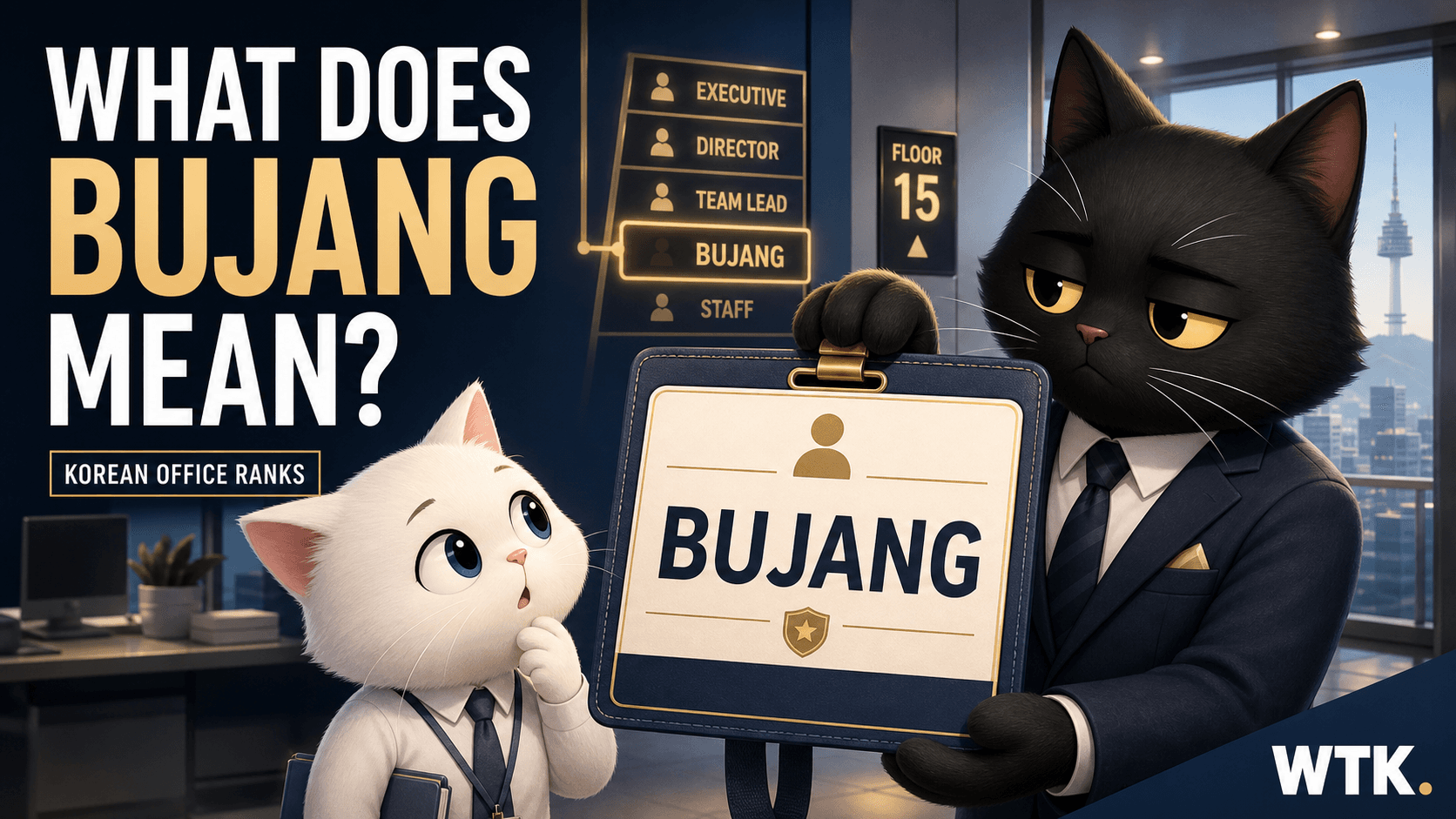
In Korean, Kim Bujang (김부장) does not initially sound like the name of an elite secret agent. It sounds like someone you might meet in an office elevator: Mr. Kim, the senior department manager who has spent years navigating reports, promotions, dinners, and executives.
That is the cultural contrast the English title Agent Kim Reactivated cannot fully carry. “Agent” reveals the hidden action hero. Bujang reveals the ordinary corporate identity hiding him.
Bujang means more than “manager”
Bujang (부장) is commonly translated as general manager, department head, or senior manager. None is a perfect match. In a traditional Korean company, it is a relatively senior employee rank below the executive tier and above several layers of manager.
The Korean government's Study in Korea employment guide presents the familiar sequence as CEO, bujang, chajang, gwajang, daeri, and sawon. Read from entry level upward, the ladder looks like this:
| Korean title | Romanization | Approximate English label | What it usually signals |
|---|---|---|---|
| 사원 | sawon | Staff / associate | Entry-level employee |
| 대리 | daeri | Assistant manager | Experienced individual contributor |
| 과장 | gwajang | Manager | Mid-level manager or senior specialist |
| 차장 | chajang | Deputy general manager | Senior rank immediately below bujang |
| 부장 | bujang | General manager / department head | Senior departmental authority |
| 이사 | isa | Director | Entry into the executive tier |
| 상무·전무 | sangmu · jeonmu | Managing director · executive vice president | Higher executive ranks |
This is a cultural map, not a universal conversion table. Companies merge ranks, use different English labels, separate rank from actual leadership roles, or discard the traditional ladder entirely.
What the title implies about a person
Calling a character Kim Bujang gives Korean viewers a bundle of expectations before he does anything.
- He has organizational history. Reaching the rank traditionally suggests years of promotions and experience inside corporate life.
- He has authority, but not unlimited power. He may direct junior employees while still answering to executives and company owners.
- He is responsible in both directions. Results come down from above; complaints and problems travel up from below.
- He fits a familiar middle-aged office-worker image. That is a stereotype, not an age requirement, but Korean dramas use it because audiences recognize it instantly.
This is why “department head” alone feels thin. Bujang describes a rank, but it also suggests accumulated time, office survival, social standing, and the pressure of being senior without being at the top.
Why people say “Kim Bujang-nim”
Korean workplaces often combine a family name with a title: Kim Bujang or, more politely, Kim Bujang-nim (김부장님). The suffix -nim adds respect. In direct conversation, a coworker may simply say bujang-nim because the title already identifies the relationship.
English speakers usually treat a job title as information placed under a name. In a traditional Korean office, the title can become part of the name people actually use. It tells everyone who is speaking to whom and what level of formality the moment requires.
The distinction between rank and role also matters. A person can hold the rank of bujang without literally running a department, while a teamjang (팀장, team leader) describes a leadership role that may be held by someone with a different personnel rank.
The ladder is changing
Not every Korean office still sounds like an old workplace drama. Technology companies, large conglomerates, and other employers have experimented with flatter systems: English nicknames, name plus -nim, or shared titles such as pro.
The trend does not mean hierarchy has disappeared. A company can remove titles from conversation while retaining differences in pay, evaluation authority, and decision making. It does mean foreign employees should not assume that every workplace uses the same ladder. Follow the employer's own directory and listen to how colleagues address one another.
POSCO E&C, for example, announced in 2025 that several management titles, including chajang and bujang, would be replaced in everyday address by the shared title “Pro.” That kind of reform only works as context: the classic hierarchy remains culturally recognizable precisely because companies keep trying to simplify it.
Why “Kim Bujang” makes the drama title work
The Korean title frames its hero as a familiar corporate type before revealing his secret past. He is not introduced as a legendary operative. He is introduced as that senior manager named Kim — a man associated with meetings, responsibility, and ordinary family life.
Then the story activates the agent underneath.
That double meaning also explains why the English title makes a reasonable marketing choice while losing something culturally useful. Agent Kim Reactivated tells overseas viewers what genre to expect. Kim Bujang tells Korean viewers what kind of ordinary man they are about to underestimate.
The series follows Korean television's weekly rhythm too. Our guide to why K-dramas release two episodes a week explains the broadcast system behind that wait.
How to translate a Korean job title without inflating it
Start with context rather than a fixed dictionary replacement. Ask whether the word is a formal rank, a functional role, or simply the form of address colleagues use. Then identify the employer, department, decision authority, and intended English-speaking audience. A business card may use “general manager,” while subtitles choose “department head” because it explains the character’s place in the scene more clearly.
For résumés and contracts, preserve the Korean title once when precision matters: “Bujang (senior department-level manager)” is safer than silently converting it into “director” or “vice president.” In conversation, follow the English title the organization itself publishes. Company hierarchies change, and two employers can use the same Korean word for different levels of authority.
The same caution applies in dramas. A character called bujang-nim may command a team but still answer to executives above them. The honorific signals workplace relationship, not unlimited power. For another Korean social system whose rules change by setting, see our guide to Korean drinking culture, including how age and rank shape a company dinner without determining every interaction.
When accuracy matters, include the original Korean title once and let the surrounding description carry the meaning instead of forcing a perfect one-word equivalent.