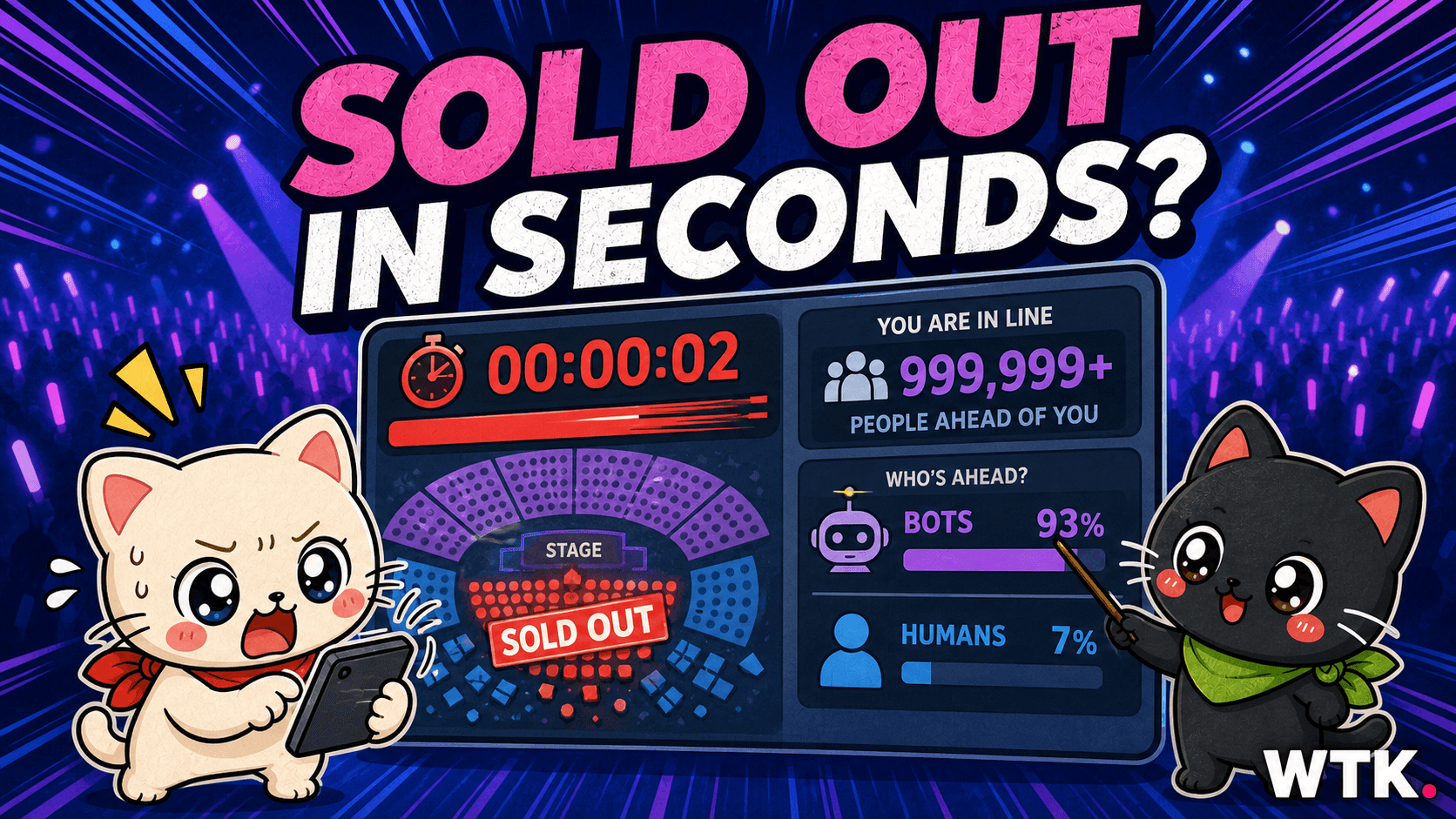
You set three alarms. You logged in early. At exactly 8:00 PM Korean time you clicked — and the entire arena was gray before the seat map finished loading. If you've ever wondered whether you were really beaten by 50,000 faster fans, here's an uncomfortable answer from Korean police: in March 2026, investigators announced a macro-assisted scalping case involving 7.1 billion won in alleged illicit profits and tickets resold for as much as 25 times face value, according to the Korea JoongAng Daily. You were not necessarily slow. You may have been racing software.
How Korean ticketing actually works
Korean concert sales are a synchronized national event, not a rolling on-sale:
- One opening moment. Tickets drop at a fixed minute on one platform (Interpark, Melon Ticket, Yes24). Fans synchronize clocks to the server's time — there are websites dedicated purely to displaying "server time" for this.
- Fan club presale first. Paid membership fans get a presale a day or two before the general sale, which routinely absorbs most good seats.
- The queue. At opening, you're thrown into a waiting line with tens of thousands of others, then race to tap seats that vanish as you look at them.
Fans treat tiketing (티케팅) as a trainable skill — there are practice simulators, warm-up drills, and a whole vocabulary: a brutal sale is piketing (피케팅, "blood ticketing"), and hunting cancelled seats later is chwiketing (취케팅).
The part that isn't fans: macros and direct links
The police case laid out the machinery working against everyone else:
- Macro programs (매크로) automate repetitive purchasing steps and refresh at machine speed, giving operators an advantage over manual buyers.
- Direct-link tools (직링, jikling) skip the waiting queue entirely, jumping straight to seat selection while humans stare at a loading bar.
- Multi-accounting defeats per-person limits (usually 4-8 tickets) using family and friends' logins — one suspect ran five accounts.
- The tools circulate commercially. Police cases show that automation is not limited to technically sophisticated operators; organized resale networks can buy access to it.
Why foreign fans get hit hardest
Every barrier above hits overseas fans twice as hard:
- Identity verification. Korean domestic platforms often require Korean phone number verification (본인인증, bonin injeung) — many foreigners never even reach the queue and must use the smaller global allocations.
- Bots eat the general sale. The global-friendly general sale is exactly the pool scalpers strip-mine, pushing foreign fans toward resellers.
- The resale trap. Overseas buyers are the scalping market's ideal customers: they can't easily verify sellers, and they're desperate enough to pay 5x. They're also the most likely to be turned away when venues check IDs against ticket names.
It's a strange inversion of the trust that runs through the rest of Korean fan culture — the same community that safely trades $500 cards in the photocard scene on timestamped photos alone, and the society famous for its leave-your-laptop honor code, treats the ticket queue as a lawless speedrun. As with bicycles, the pattern holds: anonymous, instantly resellable goods attract the professionals.
The crackdown — and changing resale rules
Enforcement and legislation are moving quickly, but the rules differ by event type and can change. In June 2026, the Culture Ministry said it had referred suspected K-pop and sports ticket scalping cases to police. Treat the organizer's current terms, official notices, and applicable Korean law as authoritative rather than relying on an old fan guide or reseller's assurances.
A realistic playbook for overseas fans
- Join the fan club. Paid membership presale is the single biggest odds boost — it's where the seats actually are.
- Use official global channels only — Interpark Global, Melon Ticket global, Yes24 Global, or the agency's announced international partner for that tour.
- Master chwiketing. Unpaid reservations return to the pool on a announced schedule a few days after opening. It's the best-kept legitimate secret in Korean ticketing.
- Practice the flow once on a low-stakes event so the seat map UI doesn't cost you seconds on the day.
- Avoid unofficial resellers. Even a face-value transfer can fail when an event bans transfers or checks the original buyer's ID.
The honest summary: yes, bots really have been taking tickets that fans — especially foreign fans — should have had. The system is finally tilting back. Until it fully does, presales and cancellation windows beat refresh speed every time.
A timeline for the week tickets go on sale
Several days before the sale, create or verify the account on the exact ticketing site named by the organizer. Check whether your fan-club membership must be linked or presale registration completed separately; buying membership after a registration deadline may not create access. Confirm that the name format matches the identification required at entry.
The day before, read the event notice again. Organizers can update purchase limits, delivery method, seat-map information, accessible seating, identity checks, or prohibited resale language. Save the official notice and order confirmation, but never post a barcode, reservation number, or personal details in a public screenshot.
After the initial sale, use only cancellation inventory or an organizer-approved resale channel. Do not pay a stranger merely because they show a queue screen or seat-map image; neither proves ownership of a transferable ticket. If the event uses mobile tickets, dynamic codes, named entry, or collection at the venue, an unofficial transfer may fail even when the original purchase was real.
What “sold out in seconds” does not prove
A fast unavailable screen does not reveal how many seats were released, how many were reserved for presales or production, how many buyers used automation, or how many orders will later be cancelled. Treat the phrase as a description of the buyer experience, not a complete measurement of demand. For the smaller randomized collectibles that use a different kind of scarcity, see our guide to K-pop photocards.
The practical response is to follow official notices, preserve account security, and treat every event's purchase and transfer rules as specific to that event.
The official-notice details worth recording
Create one event sheet with the organizer, ticketing platform, fan-club verification window, sale time and time zone, purchase limit, accepted payment methods, delivery format, name-matching rule, and official cancellation or resale channel. Save the source URL and the time you checked it. Separate an organizer announcement from a fan translation, and revisit the original notice after any update. This preparation cannot manufacture inventory, but it prevents avoidable failures such as an expired verification, unsupported card, mismatched account name, or sale time converted from the wrong time zone.