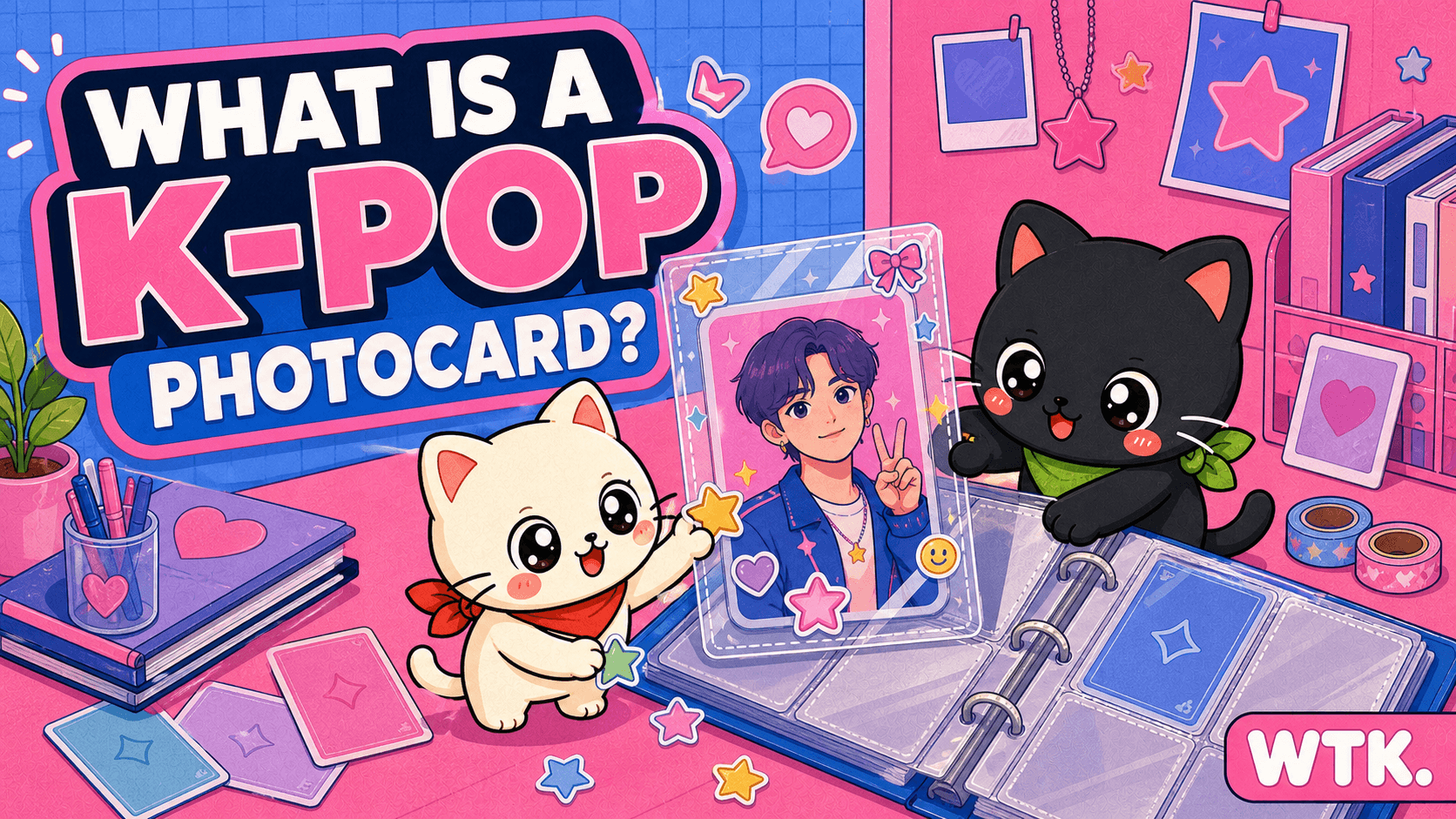
Open any K-pop album and the CD might be the least important thing in the box. The real prize is a photocard (포토카드, poto-kadeu — or just poka to fans): a wallet-sized photo of one member, randomly inserted, and the beating heart of a global collecting economy that routinely prices a 6×9cm piece of cardstock higher than the album it came in.
Where the tiny card craze came from
The photocard as we know it traces back to 2010, when Girls' Generation's Oh! album slipped a random member card into each copy. The mechanic was simple and devastating: you don't buy an album, you buy chances. A group with 10+ card variants per release turns every unboxing into a lottery — and turns bias collecting (collecting your favorite member, your choebae 최애) into a long-term project.
Agencies leaned in hard. Today cards come from everywhere: album inclusions, pre-order benefits (POB), fan-sign lucky draws, pop-up stores, even coffee collaborations. Each source has its own rarity tier, which is exactly why the aftermarket exists.
Why a card can cost more than a concert ticket
Three forces set photocard prices:
- Engineered scarcity — 1-2 random cards per album, sets of 10-30, and event-only exclusives that may exist in the low thousands of copies.
- Member demand — cards of a group's most popular members carry a visible premium; fans track "poka prices" the way sneakerheads track resale.
- Condition culture — corners, edges, and print defects are inspected like rare coins. Rare cards of top groups trade for $50-500, and graded examples of the most coveted cards have crossed the $1,000 line.
The result is a market with its own vocabulary: yangdo (양도, selling/transferring), gyohwan (교환, trading), and timestamped "proof shots" as standard etiquette.
Top-kku: when protection became decoration
The hottest corner of photocard culture right now is top-kku (탑꾸) — decorating the rigid top loader sleeve that protects a card with stickers, ribbons, glitter, and charms. What started as storage turned into a craft scene: fans build themed deco around a member's vibe, film satisfying card-spin videos for TikTok, and carry their choebae like a tiny framed portrait. Korean stationery shops now sell entire top-kku sections — the supplies themselves became a product category (very K-Goods behavior).
If you've ever wondered how idols keep that flawless card-ready complexion, that's a whole industry of its own — see our guide to glass skin.
Starting your own collection (without regrets)
- Buy the album first, once. Feel the lottery. Then decide if you're a collector or a completionist — your wallet needs to know.
- Protect immediately: penny sleeve first, then top loader. Never sleeve a card wet with... anything. Fans have opinions.
- Trade small, verify everything. Start with common cards on X or at cup-sleeve events, and treat timestamped photos as non-negotiable.
- Collect the member, not the market. Prices swing with comebacks and rumors — the only stable return is liking what's in your binder.
Album card, POB, lucky draw: the labels that matter
Not every official card has the same release path. An album inclusion is packed inside the album. A pre-order benefit (POB) comes from a particular store or preorder campaign. A lucky-draw card is tied to a limited event, while fan-sign and broadcast cards may have their own eligibility rules. Two cards from the same comeback can therefore have very different supply.
Before comparing prices, identify the group, member, album era, card image, back design, and the store or event that issued it. “Official” describes origin; it does not guarantee rarity or a particular resale value.
How to inspect a card without pretending to authenticate it
There is no universal home test that proves every K-pop photocard is genuine. Print color, cropping, corner shape, gloss, thickness, and back design can help when compared with a verified card from the exact same release, but legitimate print runs can also vary. A seller saying “looks real” is not provenance.
For a higher-value purchase:
- Ask for a current timestamped photo and a short video showing both sides and the edges.
- Compare it with the exact album or event version, not a similar selfie from another benefit.
- Check the seller’s completed transaction history and how disputes are handled.
- Use tracked shipping and a payment method with appropriate buyer protection.
- Treat an unusually low price as a reason to verify more, not as proof of a bargain.
Storage: protect the card, then decorate the holder
Collectors normally place the card in an archival-style inner sleeve before it touches a rigid top loader or binder pocket. Decorative stickers belong on the outer holder, not the card. Avoid moisture, direct sunlight, excessive heat, and soft plastic that may contain plasticizers. For long-term storage, do not force several cards into one pocket or leave heavy charms pressing against the image surface.
A photocard is a fandom membership card, a collectible, a craft canvas, and occasionally a personal collectible — all in the size of a credit card. That's a lot of power for something that falls out of an album for free.
A budget that survives more than one comeback
Separate the cost of collecting from the advertised album price. Shipping, forwarding services, customs, sleeves, binders, and repeated low-value trades can exceed the card itself. Set a monthly limit that includes those costs and keep a simple list of cards already owned; duplicate purchases often come from buying quickly across several platforms.
Choose a collection boundary before scarcity makes the decision for you. It might be one member, one album era, album inclusions only, or a small group set. Event cards and store benefits can be admired without becoming a completion requirement. A checklist made by another collector is a map, not a contract.
Trading vocabulary without the false confidence
Korean listings may use yangdo (양도) for transfer or sale and gyohwan (교환) for exchange. Terms such as 미개봉 (unopened), 하자 (defect), and 포카 (photocard) help with searching, but machine translation can miss conditions, deadlines, and whether a pictured item is merely an example. Ask for clarification before payment, particularly across languages and borders.
The healthiest collecting rule is also the simplest: the object should remain enjoyable when its resale price is ignored. For the sale systems and identity checks surrounding a much larger fandom purchase, our K-pop ticketing guide explains why official channels and event-specific rules matter more than a seller’s confidence.
A condition record for buying or trading
Ask for one continuous, well-lit view of the front, back, corners, and reflective surface with the seller's current identifier visible beside the card. Record the edition, source, claimed defects, price, shipping method, and payment protection before money changes hands. This does not authenticate a card, but it preserves what was represented. Never treat sleeve type, rounded corners, or print color alone as proof: legitimate editions can vary, and counterfeiters copy superficial checks. When certainty matters, use the platform's dispute rules and an established specialist rather than a crowd verdict from a compressed image.