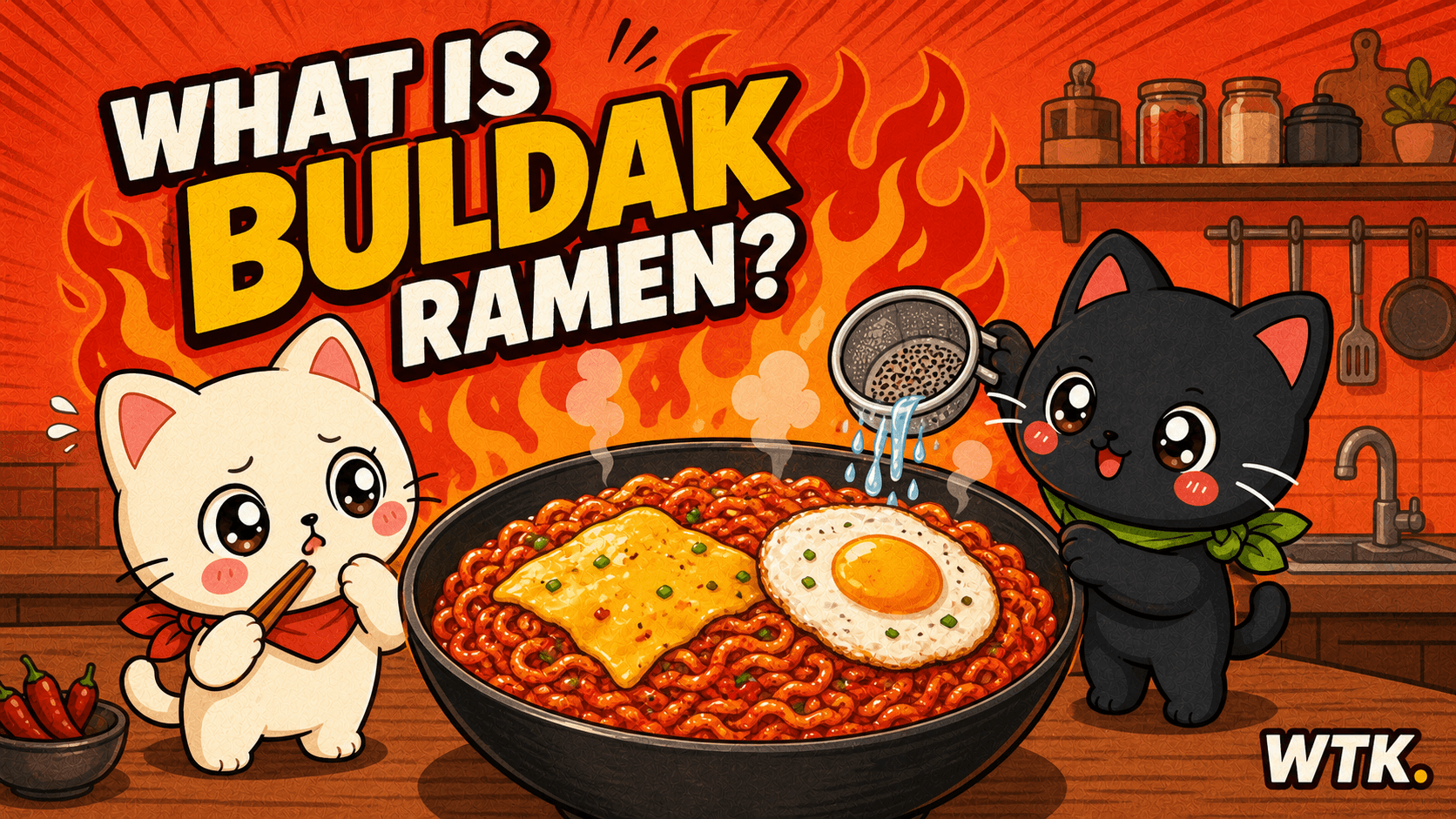
If you've spent any time on food TikTok, you've seen it: the black packet, the screaming red sauce, someone crying happily over a bowl of noodles. That's buldak ramen — literally "fire chicken stir-fried noodles" (불닭볶음면, buldak-bokkeum-myeon) — and it's Korea's most famous edible dare.
What buldak actually is
Buldak started as a dish, not a noodle. In the early 2000s, Korean restaurants served buldak — chicken grilled in a brutally spicy red pepper sauce — as drinking food. Samyang bottled that flavor into an instant noodle in 2012, and the Fire Noodle Challenge did the rest.
Two things make it different from the ramyeon you know:
- It's not a soup. You boil the noodles, drain almost all the water, and stir-fry them in the liquid sauce packet. The result is a glossy, coated noodle — closer to a spicy pasta than a broth ramen.
- The heat is sweet. Under the burn there's a smoky, slightly sweet chicken-and-soy flavor. That's why people go back after the pain fades.
The flavor lineup, ranked by fear level
- Carbonara / Cheese — the beginner tier. Creamy powder softens the perceived heat.
- Original (black packet) — the classic. Properly hot, but manageable with rice or cheese.
- 2x Spicy (red packet) — the challenge version, with a much stronger capsaicin hit.
Koreans rarely eat the hot versions plain. The standard moves: add a slice of cheese, a fried egg, or eat it alongside kimbap and cold danmuji (pickled radish). If you cook it in a traditional yangeun pot, you get bonus authenticity points — that's the gold pot you see in every Korean drama.
How to make it properly
Follow the timing and retained-water amount printed on your packet, because cup, bag, and regional versions differ. The basic method is to boil, drain most of the water, stir in the sauce over low heat, and finish with the topping packet.
Start with Carbonara or use only part of the sauce packet, then work upward. If very spicy food causes reflux or stomach pain, the challenge is not worth finishing.
How to read the packet before choosing a version
“Buldak” is now a product family, not one fixed bowl. Packet color and flavor names help, but recipes, package sizes, and labels can differ by market. Check the exact product in your hand for allergens, preparation method, nutrition information, and country-specific instructions. Do not assume a social-media Scoville chart applies to every reformulation or regional edition.
Three distinctions matter most:
- Stir-fry versus soup: classic buldak-style noodles tell you to drain most of the water. Leaving a full pot of water changes the intended dish into a diluted broth.
- Liquid sauce versus powder: many versions use both. The liquid packet usually carries much of the heat; the powder may add cheese, seasoning, or garnish depending on the variety.
- Perceived heat versus measured heat: dairy, sweetness, serving temperature, and eating pace all change the experience. A single heat number cannot predict how a bowl will feel.
Four ways to make one packet a meal
| Goal | Adjustment | Why it works |
|---|---|---|
| Less intense | Begin with part of the liquid sauce | Reduces sauce concentration without changing the noodles |
| Creamier | Add a small amount of milk or cheese after draining | Changes texture; it does not remove capsaicin |
| More balanced | Add egg and a mild vegetable | Adds substance without another seasoning packet |
| Convenience-store style | Pair with kimbap or pickled radish | Alternates spicy, savory, and cool bites |
Adding dairy may make the heat feel gentler, but it does not turn an extreme-spice product into a food suitable for everyone. Preparing only what you intend to eat is more useful than accepting a challenge to finish the packet.
A note on extreme-spice challenges
Higher-heat versions are designed as novelty-level spicy food, not a test anyone needs to complete. Children and people who are sensitive to capsaicin should be especially cautious. Stop eating if symptoms become more than temporary mouth heat, and follow local medical guidance if severe symptoms develop.
What “buldak” means outside the noodle aisle
The name combines bul (불, fire) and dak (닭, chicken). In a restaurant, buldak can refer to the spicy chicken dish that predates the instant-noodle brand. On a noodle packet, the English product name may say “Hot Chicken Flavor Ramen” even though the preparation is closer to bokkeummyeon (볶음면), a mixed or stir-fried noodle without a full bowl of broth.
That language helps decode related products. Bokkeum signals frying or mixing; myeon means noodles; maepda (맵다) means to be spicy. Carbonara, cheese, curry, or other flavor names describe the variant, not a different definition of buldak. When shopping online, match the Korean and English names with the packet image because sellers sometimes group several heat levels under one listing.
A fair way to compare flavors
Cook each version according to its own label and keep the noodle doneness and retained water consistent. Then compare more than pain:
- initial aroma and sweetness;
- how quickly the heat builds;
- whether the seasoning tastes smoky, creamy, savory, or sharp;
- noodle texture after the sauce is mixed;
- how much sauce remains at the bottom;
- whether the flavor is still enjoyable after several bites.
This produces a useful review instead of a reaction video. If you are exploring why instant noodles occupy so many Korean settings—from convenience stores to riverside parks—our longer guide to Korean ramyeon culture explains the machines, eating places, and social context around the packet.
Record the exact product name, country of sale, package size, and preparation method with the review. That small discipline makes comparisons reproducible and prevents a limited edition or reformulated packet from becoming a universal statement about the whole Buldak range. It also helps readers distinguish a flavor preference from a claim about objective heat.
Keep the tasting portion small enough that every version is evaluated under the same conditions. Water, utensils, and a neutral side dish are more useful controls than competing to finish the hottest bowl. A comparison should help the next buyer choose, not pressure them to copy a stunt.
The packet check that prevents a wrong comparison
Before ranking two packets, match the exact English and Korean product names, net weight,
preparation type, and market of sale. 볶음면 means stir-fried noodles: most of the water is
drained before the sauce is mixed. A cup version and a bag version can specify different water,
draining, and resting steps even when the flavor name looks identical. Photograph or transcribe
the directions before discarding the wrapper. If two reviewers used different water retention or
packet sizes, the result is a comparison of preparation—not only of flavor or heat.