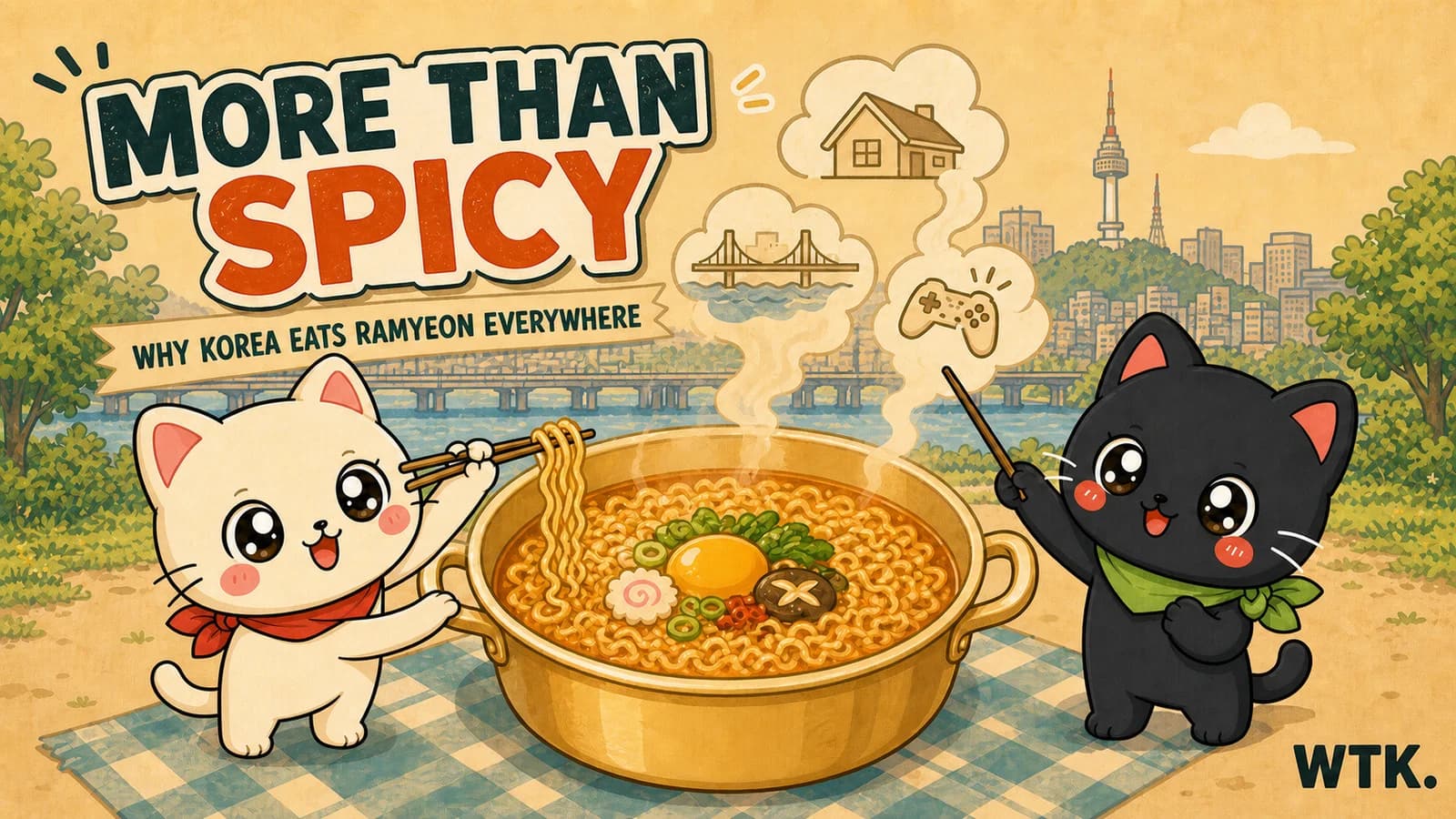
Search for Korean noodles online and you may meet a wall of red packets, sweating influencers, and warnings about “2X spicy.” That is a real part of the story, but it is not the reason ramyeon lives in Korean cupboards.
Koreans eat ramyeon (라면) when there is no time for breakfast, when friends stay up late, after a bicycle ride beside the Hangang River, between games at a PC bang, on a rainy night, after a hike, and sometimes after an already complete meal. It can be a cheap dinner, a shared snack, a hangover craving, a camping ritual, or the final carbohydrate surrender after someone says, “Should we cook just one?”
That versatility—not maximum heat—is what made ramyeon a Korean national comfort food.
Korean ramyeon is not simply Japanese ramen
The spelling looks confusing because the words share a history. In contemporary food culture, however, they usually point to different experiences:
| Word | Script | What it usually means |
|---|---|---|
| Korean ramyeon | 라면 | Instant noodles in a packet or cup |
| Japanese ramen | ラーメン | A restaurant noodle dish, though instant versions also exist |
| Chinese lamian | 拉面 | Hand-pulled wheat noodles |
If a Korean says, “I ate ramyeon at home,” most listeners imagine a factory-made block of curly noodles boiled with a seasoning packet. If someone means a Japanese ramen restaurant, they may specify Ilbon ramen (일본 라멘, Japanese ramen) or use the Japanese-style pronunciation ramen (라멘).
This distinction matters because Korean ramyeon is not trying to imitate a chef simmering tonkotsu broth for hours. Its design problem is different: how can one inexpensive, shelf-stable package become hot, intensely flavored, and emotionally satisfying in about four minutes?
The answer is an engineered system:
- a dried or fried noodle block that cooks quickly
- powdered or liquid seasoning that produces a consistent broth or sauce
- dehydrated garnish such as scallion, mushroom, seaweed, or vegetable flakes
- a recipe simple enough for a dorm room but flexible enough for endless customization
The package is not merely a shortcut to another dish. In Korea, it is its own food category.
How a 1963 emergency food became a national habit
South Korea's first domestically mass-produced instant noodle, Samyang Ramyeon, launched in 1963. Korea was still recovering from war, rice was precious, and a fast wheat-based meal appeared useful. Useful did not immediately mean beloved.
Early chicken-broth-style noodles felt unfamiliar to people accustomed to rice, soup, kimchi, and stronger seasonings. Government campaigns encouraging the consumption of wheat flour during the mid-1960s helped expand the market, while manufacturers adapted the soup toward Korean preferences. The broth became bolder and the product began to fit the familiar structure of gukmul (국물, broth): something hot, savory, and good with rice or kimchi.
Ramyeon gradually stopped being only a response to scarcity. Economic growth did not remove it from the table because convenience had become valuable in new ways. Students needed quick snacks. Factory and office workers had short breaks. Small shops could serve a hot bowl without operating a full kitchen. Families discovered that a packet in the pantry could rescue a tired evening.
By the 1990s, Korean shelves offered seafood broths, beef-bone soups, jjajang noodles, udon-like cups, oversized containers, and many regional flavor ideas. Ramyeon was no longer one emergency product. It was a library of moods.
The scale today is striking. The World Instant Noodles Association reports that South Korea consumed about 4.098 billion servings in 2024. That was roughly 79 servings per person, the world's second-highest per-capita figure for that year.
Those servings cannot all be social-media dares. Most are ordinary meals nobody films.
Seven situations that explain Korean ramyeon culture
The best way to understand ramyeon is not to rank brands. Follow the packet through a Korean day.
1. The pantry rescue
At home, ramyeon is the answer to “There is nothing to eat,” even when the refrigerator is technically full. It requires one pot, little preparation, and ingredients that can wait for months.
A parent may add an egg and scallions. A student may eat it exactly as packaged. Someone living alone may add leftover bean sprouts, half a zucchini, dumplings, or yesterday's meat. The noodles create a base into which small amounts of food can disappear gracefully.
The cookware carries nostalgia too. Many people picture ramyeon bubbling in a light, gold-colored yangeun naembi (양은냄비). The aluminum pot is not necessary, but its fast heating, rattling lid, and humble appearance have become part of the visual language of the dish.
2. The after-school and late-night snack
Ramyeon sits in the dangerous category between snack and meal. One packet can be too substantial to ignore and somehow not substantial enough to prevent adding rice.
For many Koreans, it recalls returning from school, watching television, or studying late for an exam. As yashik (야식, late-night food), it offers warmth and salt when delivery feels excessive. The phrase “one packet between us” is often an optimistic opening bid rather than a reliable forecast.
3. The Hangang convenience-store ritual
At parks along Seoul's Hangang River, convenience stores sell packet ramyeon with disposable foil bowls. Self-cooking machines dispense water and heat the noodles while a timer counts down. Customers carry the finished bowl outside to eat after walking, cycling, or picnicking.
This is Hangang ramyeon (한강 라면). The noodles are not necessarily different from those at home. The setting transforms them: river breeze, city lights, plastic chairs, friends passing around kimchi, and the satisfaction of eating something hot outdoors.
Visitors should follow the machine's instructions because the bowl and water amount are matched to the equipment. They should also sort the container and packaging into the store's designated waste bins. The ritual is communal; leaving the cleanup to the next person is not.
4. The PC bang meal that arrives at your keyboard
A PC bang (PC방) is a Korean gaming café, but modern locations can operate like small restaurants with powerful computers attached. Players order through the screen and staff deliver drinks, rice dishes, fried snacks, and ramyeon to the desk.
Ramyeon works perfectly in this environment. It is fast, strongly flavored, inexpensive, and easy to eat during a break between matches. Some PC bangs add egg, rice cake, dumplings, cheese, or sausage, turning an instant product into a made-to-order bowl.
Here convenience is not a sign that the food does not matter. The ability to eat without ending the gaming session is exactly the product.
5. The mountain reward
Korea's hiking culture has its own ramyeon memories. A cup of noodles from an authorized rest area, mountain shelter, or restaurant after the descent tastes powerful because the hiker is cold, tired, and hungry. Hot broth replaces warmth as much as calories.
This does not mean hikers may light a stove anywhere they like. Many Korean parks and mountains restrict flames and cooking because of wildfire risk. The cultural image is real; the correct place to recreate it is a permitted facility or after the hike.
6. The military memory
For generations of Korean men who completed compulsory service, ramyeon is tied to the PX (피엑스, military store), night duty, seniority, and improvised snacks. One famous method called ppogeuri (뽀글이) involved pouring hot water directly into a packet.
It survives as barracks folklore, but it is not a cooking recommendation: ordinary outer packaging is not designed to function as a bowl for boiling water. Use a proper heat-safe container.
What matters culturally is the memory of a restricted environment where one familiar packet could become a private reward. Korea's first dedicated ramyeon critic, Ji Young-jun, has said that tasting products from a military PX helped begin the project that eventually became his career and a book about ramyeon history.
7. The extra noodle in a shared dish
Ramyeon can also enter a meal without bringing its soup packet. A plain noodle block added to budae jjigae (부대찌개, army-base stew), tteokbokki, or a bubbling hot pot is called ramyeon sari (라면 사리), an extra noodle portion.
The noodle absorbs the existing sauce and extends a shared dish for the whole table. This reveals one reason ramyeon fits Korean dining so well: it can be individual and communal, complete and supplementary, cheap and still eagerly anticipated.
Buldak is one branch, not the whole ramyeon tree
Buldak Bokkeum Myeon matters. Its dry, fiery sauce, mascot branding, and online challenge culture helped a Korean product reach people who had never visited a Korean grocery store. But using Buldak to define all Korean ramyeon is like using hot wings to define every American sandwich.
Korean ramyeon includes at least four broad experiences:
| Style | Korean clue | What to expect |
|---|---|---|
| Red soup | maeun gungmul (매운 국물) | Chili heat with beef, mushroom, seafood, or vegetable flavors |
| Mild soup | sagol, gomtang, dak (사골·곰탕·닭) | Beef-bone, clear meat, or chicken-style comfort broths |
| Dry or stir-fried | bokkeummyeon (볶음면) | Sauce-coated noodles with little or no broth |
| Black-bean or mixed | jjajang, bibim (짜장·비빔) | Sweet-savory black bean or tangy mixed noodles |
Even “spicy” is not one flavor. A soup can be peppery, garlicky, smoky, seafood-forward, or gently warming. The point is not always pain. Often the heat simply keeps a rich, salty broth from tasting flat.
For a first purchase, ignore viral rankings and choose by situation. Pick a mild soup when you want comfort, a seafood broth when you want briny depth, a dry noodle when you want a snack-like meal, and an extra-hot product only when that experience is genuinely what you enjoy.
How Koreans personalize one packet
Cooking arguments begin before the water boils. Powder first or noodles first? Lid on or off? Break the block? Add the egg whole, stir it into ribbons, or refuse to let it touch the broth?
The safest answer is to follow the package once. Manufacturers formulate each noodle thickness, water volume, and cooking time differently. After learning the intended texture, customize.
Common additions include:
- Egg: dropped whole for a soft yolk or stirred for a thicker broth
- Green onion and chili: freshness and aroma
- Kimchi: acidity and fermentation, usually served beside the bowl
- Tteok or mandu: rice cakes or dumplings for a heavier meal
- Bean sprouts or cabbage: crunch and volume
- Cheese: softens sharp heat and creates a creamy texture
- Rice: added to the remaining soup as the final act
Many diners prefer kkodeul-kkodeulhan myeon (꼬들꼬들한 면), noodles that remain firm and springy. The opposite is peojin myeon (퍼진 면), noodles swollen from cooking too long. Some people love the softer texture, but calling noodles peojyeotda (퍼졌다) usually sounds like a complaint.
And then there is myeonchigi (면치기), loudly slurping noodles in a continuous pull. Korean food television made the technique highly visible, but it is performance, not a mandatory table-manners test. Eat without spraying broth on your companions and you are already doing well.
“Do you want to eat ramyeon?” may not be about dinner
K-dramas gave one ramyeon sentence a second life:
라면 먹고 갈래?
Ramyeon meokgo galla?
“Do you want to have ramyeon before you go?”
In the right late-night context, inviting someone inside for ramyeon can imply romantic or sexual interest—roughly the cultural territory of “Netflix and chill.” The association became famous through Korean film and television, then turned into a joke audiences recognize immediately.
Context remains essential. A friend asking whether you want ramyeon at a campsite may simply believe you look hungry. A convenience-store employee pointing to a cooking machine is not proposing anything. Tone, location, relationship, and time of night do the work; the noodles alone are innocent.
Ramyeon also performs less suggestive emotional jobs on screen. It shows that a wealthy character wants ordinary comfort, that two strangers are becoming informal, or that someone is too exhausted to cook. A pot placed between characters can create intimacy without a restaurant, reservation, or formal date.
Is ramyeon an everyday food or an occasional food?
Culturally, it is everyday food. Nutritionally, it is better understood as a convenient processed meal rather than a complete daily diet.
Products vary, so the label matters. Many instant noodles are high in sodium, and some fried noodle blocks contain substantial fat. A bowl eaten alone may also be low in vegetables, fiber, and protein. Korean public-health research has identified noodles, including instant noodles, as a meaningful source of dietary sodium. Manufacturers have reduced sodium in major products over time, but “less than before” does not make every broth light.
Practical choices are less dramatic than internet detox advice:
- add vegetables and a protein instead of only increasing noodle portions
- compare sodium and saturated-fat values on packages
- use less seasoning if the product still tastes good to you
- leave some soup rather than drinking every drop when limiting sodium
- enjoy ramyeon as one food within a varied diet
The goal is not to “cleanse” a beloved food until it becomes punishment. It is to let a four-minute convenience meal remain convenient without asking it to provide everything your body needs.
The real reason ramyeon feels Korean
Ramyeon did not originate as an ancient royal recipe. It arrived in industrial, postwar Korea and became Korean through repetition and adaptation.
Manufacturers made its broth speak the language of Korean soups. Families added kimchi, eggs, rice cakes, and leftovers. Soldiers, students, gamers, hikers, office workers, and Hangang picnickers attached different memories to the same curly block. Restaurants turned it into sari for shared stews. Film and television turned an invitation to eat it into flirtation.
Its strength is not that it is the world's spiciest noodle. Its strength is that it can enter almost any Korean situation and know what job to do.
Sometimes that job is dinner. Sometimes it is recovery, warmth, friendship, nostalgia, or an excuse not to say goodnight yet. Buldak made Korean ramyeon globally spectacular. Everyday life is what made it Korean.
Sources
- World Instant Noodles Association — Global demand table for instant noodles
- Korean Cultural Center — Ramyeon as Korea's national food
- Korean Cultural Center — Ramyeon varieties, history, and home preparation
- Korea.net — Eating convenience-store ramyeon by the Hangang River
- Korea.net — Seoul's Ramyun Library and self-cooking machines
- The Korea Times — Korea's pioneering instant-noodle critic
- BMJ Nutrition, Prevention & Health — Progress on sodium reduction in South Korea
- Nutrition Research and Practice — Instant noodles and Korean adult nutrient intake