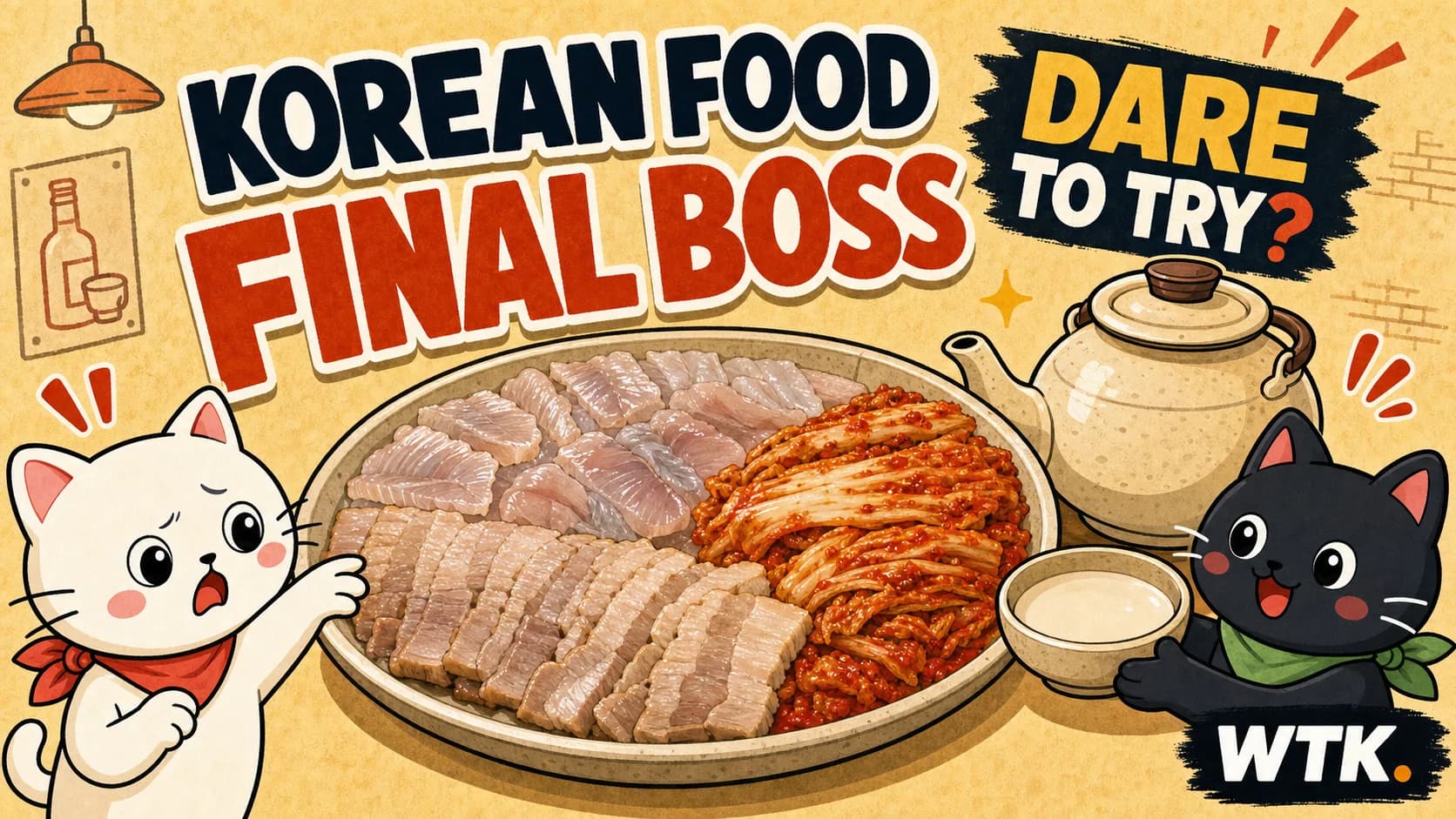
You have mastered kimchi, ordered extra-spicy ramyeon, and stopped asking for a fork at the barbecue table. Are you ready for Korea's advanced anju?
These challenging Korean drinking foods are not difficult simply because they are Korean. They test a diner's comfort with powerful fermentation, chewy offal, visible anatomy, unfamiliar seafood, or serious chili heat. Some divide Korean diners just as sharply as visitors. Think of this as a tasting map—not a bravery contest.
If anju (안주, food eaten with alcohol) is new to you, begin with our guide to Korean food and alcohol pairings. This is the advanced level.
The Korean anju difficulty scale
There is no official ranking. This scale measures how many unfamiliar sensations arrive in the same bite.
| Level | Food | Usual drink partner | Main challenge |
|---|---|---|---|
| 1 | Dakbal | Soju or beer | Very spicy sauce and chewy chicken feet |
| 1 | Golbaengi muchim | Beer or somaek | Springy sea-snail texture and sharp dressing |
| 2 | Gopchang and daechang | Soju | Offal aroma and rich, fatty chew |
| 2 | Beondegi | Soju or beer | Silkworm pupae and an earthy aroma |
| 3 | Gwamegi | Soju or makgeolli | Concentrated half-dried fish flavor |
| 3 | Sannakji | Soju is common, but skip alcohol for a first try | Moving pieces and choking risk |
| Final boss | Hongeo samhap | Makgeolli | Fermented skate's ammonia-like aroma and sting |
The drink pairings describe common restaurant habits, not medical protection. Alcohol does not make raw seafood safer, cancel extreme spice, or prove that you ate something correctly.
Level 1: unfamiliar, but friendly enough
Dakbal and soju: heat, bones, and serious chew
Dakbal (닭발, chicken feet) is commonly stir-fried or braised in a red, sweet-hot sauce. The skin and connective tissue create a springy, collagen-rich texture with very little meat. Bone-in dakbal requires patient nibbling; mupyeo dakbal (무뼈닭발, boneless chicken feet) removes that technical challenge.
Soju is the classic order, while beer brings cold carbonation to the chili-heavy sauce. Neither erases capsaicin. Rice balls, steamed egg, or cool soup are more useful between bites.
Beginner move: order boneless dakbal at a lower spice level. If you already enjoy the burn of buldak ramen, the texture—not the heat—will probably be the new test.
Golbaengi muchim and beer: the chewy pub classic
Golbaengi muchim (골뱅이무침) mixes sliced sea snails with vegetables and thin wheat noodles in a spicy, sweet, vinegary sauce. Its bright seasoning is familiar to anyone who likes Korean spicy salads. The surprise is the firm, bouncy bite of the shellfish.
Beer is a natural partner, and old-school pubs often serve the dish for a group. In Seoul's Euljiro area, sea-snail dishes and dried pollack became neighborhood beer snacks.
Beginner move: mix every component thoroughly and start with a small snail slice, noodles, and cucumber in the same bite. The contrast is easier than eating the seafood alone.
Level 2: texture becomes the main event
Gopchang and daechang with soju
Gopchang (곱창) refers to small intestines, while daechang (대창) is large intestine. Specialist restaurants grill cleaned pieces until the exterior browns and the inside stays chewy or rich. Daechang is especially fatty, so a little can feel like a lot.
Chilled soju supplies a clean pause between rich bites. Chives, garlic, kimchi, and a final round of fried rice keep the meal from becoming one-note. The social grill is part of the appeal, much like the cauldron-lid barbecue described in our sotdukkeong guide.
Beginner move: choose a busy specialist restaurant and order a mixed platter. Proper cleaning and confident grilling matter more here than toughness.
Beondegi with soju or beer
Beondegi (번데기) are seasoned silkworm pupae. They may arrive as a warm broth in a small pot or as a canned convenience-store snack. The first hurdle is visual and psychological; the second is a soft, grainy texture and an earthy, nutty aroma.
The flavor is far less dramatic than the ingredient sounds. A light lager keeps the snack casual, while soju matches the old-school street-stall atmosphere.
Beginner move: try one warm spoonful with broth instead of staring at the whole bowl. You are tasting a Korean snack tradition, not signing a contract to love it.
Level 3: advanced seafood territory
Gwamegi with soju or makgeolli
Gwamegi (과메기) is half-dried fish, traditionally associated with winter on Korea's east coast. Drying concentrates its marine aroma and gives it an oily, dense, chewy texture. It is commonly wrapped in seaweed or leafy greens with garlic, chives, and cho-gochujang (초고추장, spicy-sour chili sauce).
Soju answers the concentrated oiliness with a clean finish. Makgeolli creates a softer, earthier combination.
Beginner move: do not begin with a plain slab. Build the complete wrap so seaweed, vegetables, garlic, and sauce share the bite.
Sannakji: not a drinking challenge
Sannakji (산낙지) is recently killed small octopus cut into pieces and dressed with sesame oil and sesame seeds. The pieces can still move because nerve activity continues after cutting. That movement creates the spectacle—and the risk.
The suction cups may still grip, so sannakji can be a choking hazard. Alcohol can impair judgment and chewing, which makes “sannakji with soju” a poor first-timer challenge even if the combination appears in seafood restaurants.
Safe move: order from a reputable restaurant, ask for smaller pieces, place only one piece in your mouth, and chew completely before swallowing. Do not eat it while intoxicated, and skip it if you have swallowing difficulties. Cooked octopus offers the chew without the same spectacle.
Final boss: hongeo samhap and makgeolli
Hongeo (홍어) is fermented skate. During fermentation it develops the famous ammonia-like aroma and a sharp sensation that can travel from the mouth toward the nose. This is not a hidden flavor that only foreigners notice. Hongeo is proudly regional, deeply loved by its fans, and intensely polarizing within Korea.
The expert form is hongeo samhap (홍어삼합, “three-part combination”):
- A piece of aged kimchi
- A slice of fermented skate
- A slice of suyuk (수육, boiled pork)
They are eaten together. Sour kimchi meets the skate's pungency, while the pork adds fat and a gentler texture. Makgeolli completes the classic Jeolla-do combination with soft grain flavor, mild sweetness, and acidity.
Beginner move: tell the restaurant yakage juseyo (약하게 주세요, “please give me a mild one”) if different fermentation strengths are available. Take a small complete samhap bite rather than isolated skate. Breathe normally, chew slowly, and decide for yourself. There is no prize for pretending.
How to order like an experienced beginner
Long-term residents do not become food experts by forcing down everything. They learn how to set up a fair first taste.
- Go to a specialist. Strong ingredients punish careless storage, cleaning, or preparation.
- Ask for the accessible version. Boneless dakbal, a mixed gopchang platter, or mildly fermented hongeo can be sensible entry points.
- Build the intended bite. Gwamegi needs its wrap; hongeo works as samhap; golbaengi needs noodles and vegetables.
- Share one order. Most anju is designed for a table, so curiosity does not require finishing a large plate alone.
- Keep the drink optional. Water, tea, sparkling water, and nonalcoholic beer all work. Never let a drinking group turn consent into a test.
- Check ingredients. Seafood and shellfish allergies, pork restrictions, spice sensitivity, and swallowing problems matter more than the ranking.
The real “Korea expert” move is not eating the strangest thing with the strongest drink. It is understanding why people value a food, tasting it in the form its fans recommend, and being comfortable saying either masisseoyo (맛있어요, “it's delicious”) or je chwihyang-eun anieyo (제 취향은 아니에요, “it isn't my taste”).