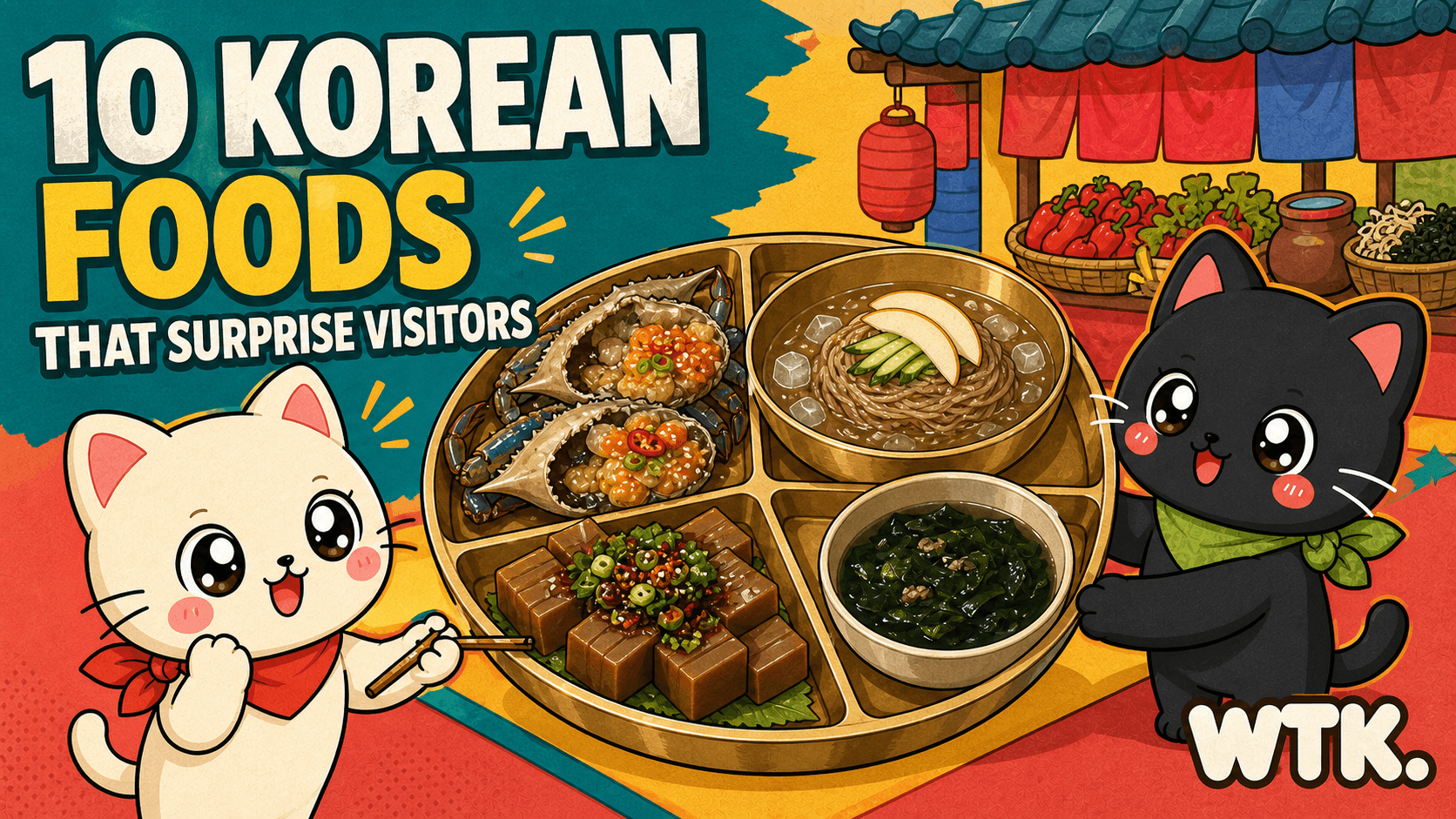
You expected barbecue, fried chicken, and red-hot noodles. Then someone placed a raw crab shell in front of you, offered noodles floating among ice cubes, and explained that the brown pudding on the table was made from acorns.
Korean food can surprise a first-time visitor through ingredients, temperature, texture, aroma, names, and the moment a dish is eaten. These 10 surprising Korean foods are not a dare list. They are a map of delicious ideas that may work differently from the food rules you grew up with.
The 10 most surprising Korean foods at a glance
This ranking measures the size of the cultural surprise, not how “strange” or difficult a food is. Several dishes near the top are easier to enjoy than their descriptions suggest.
| Rank | Food | What surprises first-timers | Beginner difficulty |
|---|---|---|---|
| 10 | Miyeokguk | Seaweed soup is Korea's birthday food | Easy |
| 9 | Gamjatang | “Potato soup” is built around pork bones | Easy–medium |
| 8 | Dotorimuk | Acorns become a cool savory jelly | Easy |
| 7 | Kongguksu | Noodles arrive in cold, unsweetened soy milk | Easy–medium |
| 6 | Naengmyeon | Chewy noodles and broth can contain ice | Medium |
| 5 | Jokbal | A glossy pig's foot becomes a popular delivery feast | Easy–medium |
| 4 | Cheonggukjang | Fast-fermented soybeans create a huge aroma | Medium–hard |
| 3 | Sundae | It is blood sausage, not an ice cream dessert | Medium |
| 2 | Ganjang gejang | Raw crab is cured in soy sauce and eaten with rice | Hard |
| 1 | Hongeo samhap | Fermented skate produces an ammonia-like intensity | Final boss |
The “difficulty” is only a starting point. A diner who loves blue cheese may handle fermentation better than icy buckwheat noodles, while a seafood fan may rank raw crab as the easiest dish on the table.
10. Miyeokguk: the soup that says “happy birthday”
Miyeokguk (미역국, seaweed soup) looks like a modest home meal: slippery brown-green seaweed simmered in beef, anchovy, shellfish, or fish broth. The surprise is when it appears. Koreans traditionally eat it on birthdays.
The custom connects birth with mothers. Seaweed soup has long been associated with postpartum meals, so eating it on your birthday acknowledges the person who gave birth to you as well as celebrating your own arrival. In Korean dramas, asking “Did you eat miyeokguk?” can function almost like saying “Happy birthday.”
First-timer move: try a beef version for the most familiar savory profile. Do not expect a decorative party dish; its emotional power comes from tasting like home.
9. Gamjatang: why is “potato soup” full of pork bones?
Gamjatang (감자탕) is a deep red stew filled with pork backbone or neck bones, potatoes, greens, perilla leaves, and nutty perilla-seed powder. The bones, rather than the potatoes, dominate the pot.
That creates a famous translation trap. Gamja usually means potato, but explanations of the dish's name vary, and a menu translation such as “potato soup” does not tell you that you will be picking tender pork from large bones. What looks messy is extremely comforting: rich broth, soft meat, fluffy potato, and aromatic perilla.
It is often shared at the table, while the single-serving relative ppyeodagwi haejangguk (뼈다귀해장국, pork-backbone hangover soup) comes in an individual bowl.
First-timer move: use chopsticks to pull off loose meat and a spoon for broth. Do not wear white if you plan to wrestle enthusiastically with red soup.
8. Dotorimuk: acorns turned into savory jelly
In many countries, acorns are associated with squirrels, forests, or famine history—not with a restaurant side dish. Korea turns acorn starch into dotorimuk (도토리묵), a smooth brown jelly with a mild, faintly bitter taste.
The jelly is commonly sliced and served as dotorimuk muchim (도토리묵무침), mixed with vegetables, seaweed flakes, and a soy-based dressing. Its cool wobble resembles pudding, but the flavor is savory. It can also appear with rice in chilled broth.
First-timer move: lift a slice gently; squeezing with metal chopsticks can cut it in half. Take jelly, a leaf, and dressing together. This is one of the friendliest foods on the list and a useful reminder that unfamiliar texture does not mean aggressive flavor.
7. Kongguksu: cold noodles in unsweetened soy milk
Imagine a bowl of noodles in a thick, pale drink that looks like cream. Now remove the dairy, sweetness, and heat. Kongguksu (콩국수) is a summer dish of wheat noodles in a chilled broth made from ground soybeans.
The first spoonful can feel confusing because many visitors expect dessert-like soy milk. Traditional kongguksu is nutty, restrained, and usually seasoned at the table. Some regions and households prefer salt; others add sugar, a choice capable of starting a surprisingly serious Korean debate.
First-timer move: taste the broth before seasoning. Add only a little salt at a time. The point is the clean soybean flavor, not turning the bowl into conventional noodle soup.
6. Naengmyeon: noodles served colder than your drink
Mul naengmyeon (물냉면) places long, chewy noodles in a cold broth that may arrive with crushed ice or visible ice crystals. Vinegar and hot mustard wait on the table. For visitors trained to expect noodles steaming, it can look as if the kitchen forgot to heat the soup.
Cold is the design, not a mistake. Pyongyang-style naengmyeon is associated with a subtle buckwheat noodle and restrained broth, while Hamheung-style traditions are known for chewier starch noodles and spicy seasoning. Naengmyeon was historically enjoyed in winter as well as becoming a modern summer favorite.
The noodles may be difficult to bite cleanly. Restaurants often provide scissors, but some enthusiasts prefer keeping the strands long.
First-timer move: taste the original broth before flooding it with vinegar and mustard. Then adjust gradually. If a bowl arrives after Korean barbecue, the cold, sharp finish makes sense immediately.
5. Jokbal: pig's feet as a late-night delivery classic
The English words “pig's feet” can sound austere. Jokbal (족발) arrives as a glossy platter of neatly sliced pork, braised with soy sauce and aromatics until the meat is tender and the skin pleasantly springy.
It is a group meal and a popular delivery order, often served with lettuce, garlic, saeujeot (새우젓, salted shrimp), and spicy buckwheat noodles. The contrast between soft meat and chewy skin is the attraction. Jangchung-dong in Seoul became closely associated with jokbal businesses established by people displaced from northern Korea after the Korean War.
First-timer move: begin with a leaner slice in a lettuce wrap, then try a piece with more skin. If you already enjoy samgyeopsal, jokbal is less a leap than it sounds.
4. Cheonggukjang: fermentation announces itself at the door
Cheonggukjang (청국장) is a quickly fermented soybean paste commonly cooked into a stew with tofu, kimchi, mushrooms, onions, or meat. Its earthy, funky aroma can fill a restaurant—and cling to clothing—before the bowl reaches the table.
Visitors sometimes compare it with natto because both involve fermented soybeans, but the finished Korean stew has its own character. It is hot, rustic, bean-rich, and less about chili heat than deep fermentation. Even Koreans differ sharply on the smell.
First-timer move: eat a spoonful with rice rather than drinking the broth alone. Choose a specialist or a country-style set-menu restaurant, where vegetables and side dishes balance the concentrated stew.
3. Sundae: the Korean sausage that is not dessert
Say you want a “sundae” in Korea and you may receive sliced sausage beside liver and salt. Sundae (순대, pronounced roughly soon-dae) is made by filling an intestine casing. Common street and market versions often contain dangmyeon (당면, glass noodles), producing a soft, springy interior.
Recipes vary widely. Pisundae (피순대) emphasizes pork blood and has a darker, richer filling; regional versions may include vegetables, grains, or other ingredients. Sundae can be steamed and sliced, stir-fried with vegetables, or dropped into sundaeguk (순대국), a porky soup that may contain offal.
First-timer move: start with standard market sundae dipped in salt or seasoned salt. Ask what is on the side plate before assuming every piece is sausage. For a full meal, try Sillim's stir-fried white sundae with vegetables, noodles, and perilla.
2. Ganjang gejang: raw crab known as a “rice thief”
Ganjang gejang (간장게장) is raw blue crab marinated in a seasoned soy sauce. The shell is opened to reveal soft flesh and rich innards; diners squeeze out meat, suck it from shell sections, and mix warm rice into the carapace.
Koreans call intensely appetizing dishes like this bap doduk (밥도둑, “rice thief”) because the salty, savory flavor makes rice disappear. The orange roe and translucent flesh can be visually challenging, while fans prize exactly that creamy ocean flavor. Yangnyeom gejang (양념게장) replaces the soy-centered marinade with a red spicy sauce.
Marinating is not cooking. Raw crab requires reliable sourcing, strict refrigeration, and careful handling. People who are pregnant, immunocompromised, elderly, very young, or medically advised to avoid raw seafood should choose a cooked crab dish instead.
First-timer move: visit a busy gejang specialist, order a set meal, and ask staff to demonstrate the shell. Keep rice ready—the nickname is accurate.
1. Hongeo samhap: Korea's famous fermentation final boss
Hongeo (홍어) is fermented skate, celebrated particularly in Korea's southwest. Skate retains urea in its tissues; fermentation produces an ammonia-like aroma and a sharp sensation that can travel through the nose. It is so intense that plenty of Koreans avoid it too.
The classic format is hongeo samhap (홍어삼합, “three-part combination”): fermented skate, boiled pork, and aged kimchi in one bite. Fatty pork and sour kimchi do not erase the skate, but they make the experience more balanced. Makgeolli is a traditional partner.
This is not a test of respect for Korean culture. Regional food deserves curiosity, not forced admiration. Our guide to Korea's hardest drinking foods explains hongeo and other advanced anju in more detail.
First-timer move: ask whether a milder fermentation level is available and take a small, complete samhap bite. It is perfectly polite to decide that one is enough.
How to try surprising Korean food without turning it into a stunt
The worst way to explore this list is to film a disgusted face before tasting anything. The best way is to understand how the food is intended to work.
- Order the complete format. Dotorimuk needs dressing, jokbal needs wraps and salted shrimp, and hongeo makes more sense as samhap.
- Use a specialist restaurant. This matters especially for raw seafood, fermentation, offal, and cuts requiring long preparation.
- Share one portion. Many dishes are designed for a table, not one person's challenge video.
- Ask what is raw.
이거 날것이에요?(igeo nalgeos-ieyo?) means “Is this raw?” - Mention allergies and restrictions. Crab, shrimp paste, anchovy broth, pork, blood, soy, wheat, and sesame appear across this list.
- Learn the texture before judging the flavor. “Chewy,” “slippery,” and “jelly-like” describe physical experiences, not quality failures.
Korean eating culture also loves apparent opposites. People eat scorching samgyetang in summer, icy noodles in winter, and fried rice after saying the meal is finished. The surprise often disappears once you understand the sequence, season, or social meaning.
The real surprise is how quickly “weird” becomes comfort food
Not every visitor will enjoy every dish, and Koreans do not agree on them either. That is precisely why this list is more useful than a collection of shock reactions.
Miyeokguk may begin as “seaweed for a birthday” and become the soup you crave when homesick. Cold kongguksu may taste unfinished on the first spoon and perfect during a humid Seoul summer. Ganjang gejang may look impossible until rice meets the soy-rich crab shell.
The goal is not to finish all 10. It is to discover which food rule you are willing to rewrite.
Sources
- VISITKOREA: Ganjanggejang, Korea's Ultimate “Rice Thief”
- VISITKOREA: Sundae with Pork Blood
- VISITKOREA: Rich Soybean Paste Jjigae (Cheonggukjang)
- VISITKOREA: Braised Pigs' Feet (Jokbal)
- VISITKOREA: Noodles in Cold Soybean Soup (Kongguksu)
- Korea.net: Naengmyeon History and Recipe
- VISITKOREA: Acorn Jelly Salad (Dotorimuk)
- VISITKOREA: Pork Backbone Stew (Gamjatang)
- VISITKOREA: Why Koreans Eat Miyeokguk on Birthdays
- VISITKOREA: Skate and Hongeo Samhap
- CDC: Food Safety Tips for Raw or Undercooked Seafood