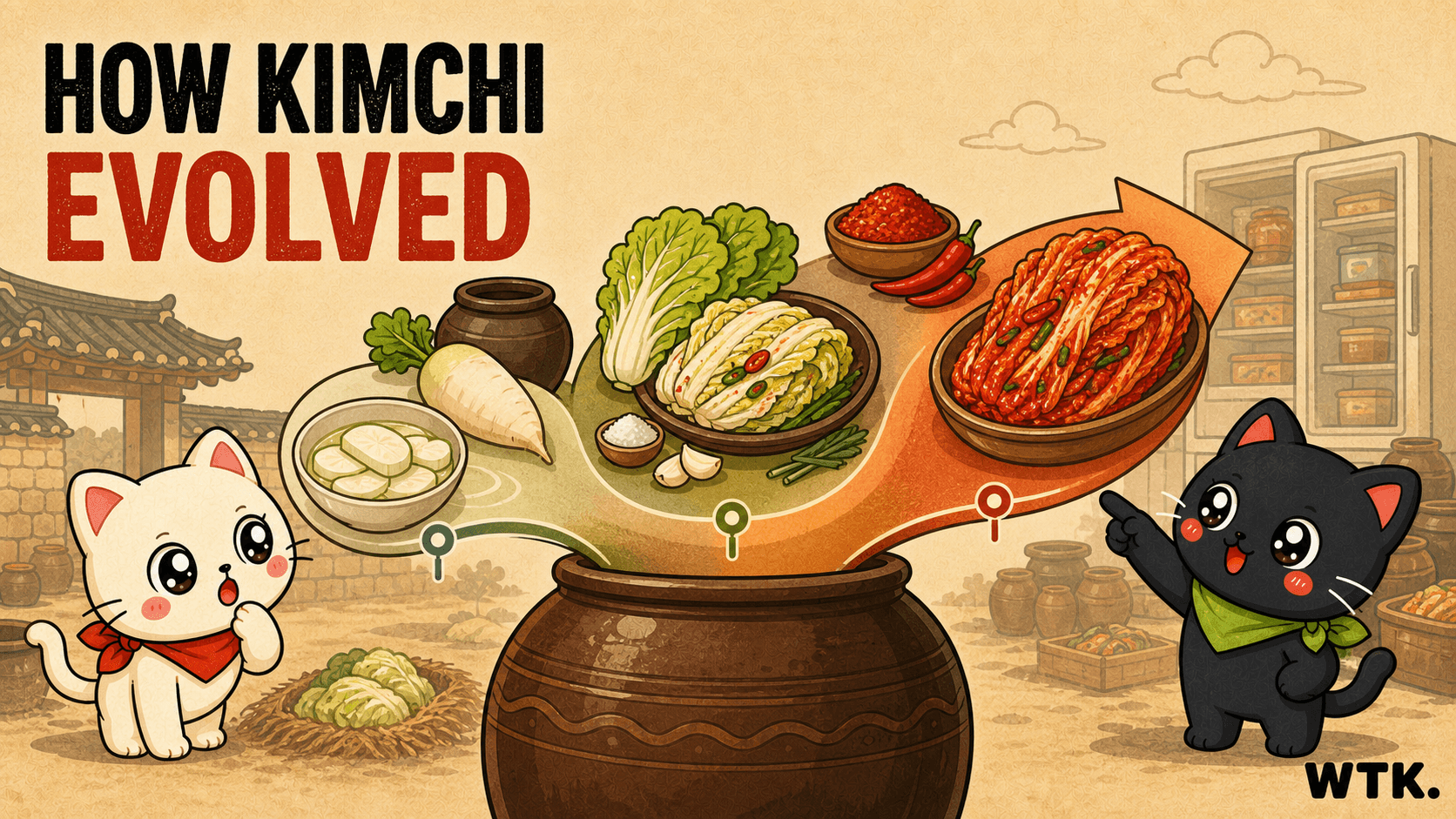
Ask someone outside Korea to picture kimchi and one image usually appears: folded napa cabbage leaves covered in red pepper seasoning. That is baechu kimchi (배추김치), today's international standard. It is also one of the later chapters in a much longer history.
Kimchi did not spring fully formed from one ancient recipe. It evolved as Korean cooks adapted vegetables, salt, fermentation, spices, seafood, farming, climate, and storage to different places and centuries. Understanding that evolution makes the modern bowl more interesting—and explains why Korea has far more than one kind of kimchi.
Kimchi history in six stages
| Period | Typical development | What not to assume |
|---|---|---|
| Ancient precedents | Salted and fermented vegetables across East Asia | Every old pickle was modern Korean kimchi |
| Goryeo period | Korean records mention salted turnip for winter | The dish was red or cabbage-based |
| Early Joseon | Brined vegetables, garlic, ginger, aromatic seasonings | Chili was always essential |
| Mid-to-late Joseon | Chili, seafood seasonings, and more elaborate recipes spread | One recipe replaced all earlier kimchi |
| 19th–20th centuries | Improved headed cabbage helped stuffed baechu kimchi become prominent | Today's cabbage was unchanged for centuries |
| Modern era | Refrigeration, industrial production, exports, and global adaptation | Factory kimchi ended household traditions |
The important word is development. A food can have deep roots without every modern ingredient being ancient.
Before red cabbage: preserving vegetables through winter
The broad ancestor of kimchi is salted vegetable fermentation. Fresh vegetables spoil quickly, especially when a farming household needs food through a cold winter. Salt draws water from plant tissue and helps create conditions in which lactic-acid bacteria can acidify the vegetables. The process changes flavor and texture while extending usefulness.
Old Chinese texts record foods called jeo (저, 菹), a term for fermented or pickled vegetables. These records matter as regional precedents, but historians caution against calling every ancient jeo “kimchi” in the modern national sense. Techniques and words traveled across East Asia; Korean kimchi developed its own ingredients, liquid-rich styles, terminology, and social practices over time.
The earliest clear Korean literary reference often cited comes from Yi Gyubo's twelfth-century writings during Goryeo. A poem describes turnip preserved for winter with salt. The vegetable was not a tightly packed napa cabbage, and there was no red pepper paste. It was closer to a simple salted radish or turnip preserve.
That is not a disappointing prototype. It reveals kimchi's original problem: how to keep the harvest edible when the growing season ends.
From ji and dimchae to the word kimchi
Kimchi has not always carried its present name. Historical Korean sources used terms including ji (지), jeo (저), and dimchae (딤채). One widely cited linguistic explanation connects dimchae to chimchae (침채, “submerged vegetables”), reflecting the way salted vegetables release liquid and sit in brine. Through sound changes, dimchae eventually became gimchae and then gimchi.
The etymology is useful because it restores liquid to the picture. Modern export photos favor neat red cabbage leaves, but Korean kimchi includes brothy forms such as dongchimi (동치미, radish water kimchi) and nabak kimchi (나박김치, sliced vegetable water kimchi). White kimchi, cucumber kimchi, mustard-leaf kimchi, and green-onion kimchi belong to the same family without looking alike.
Early Joseon recipes relied on salt, brine, and aromatics available before chili became common. Garlic, ginger, mustard, Sichuan pepper-like spices, and fermented seafood could all shape flavor. Some preparations were clear and refreshing; others were strongly salted for storage.
Chili changed kimchi—but not overnight
Chili peppers originated in the Americas and reached East Asia through early modern trade. They entered Korea during the Joseon period, centuries after the first salted vegetable records. This single fact disproves the idea that ancient Korean kimchi was always bright red.
Nor did chili enter one day and transform every jar the next. Seeds had to circulate, farmers had to grow the crop, cooks had to test it, and regional preferences had to form. Korea's Academy of Korean Studies points to the eighteenth-century Jeungbo Sallim Gyeongje (증보산림경제) as evidence of chili used in kimchi recipes. The text includes preparations resembling modern cucumber and young-radish kimchi.
Chili offered more than heat. Dried gochugaru (고춧가루, Korean red-pepper flakes) added color and a warm, fruity flavor that worked with garlic, ginger, scallions, and jeotgal (젓갈, salted seafood). But white kimchi and water kimchi did not disappear. The new ingredient expanded the repertoire rather than erasing it.
This is a recurring pattern in kimchi history: new forms accumulate beside old ones.
Napa cabbage was not always today's napa cabbage
Cabbage appears in Korean records as early as the Goryeo period, but the plant itself changed. Earlier varieties were loose-leaf or only partly headed. The dense, tightly packed napa cabbage familiar in supermarkets is not an unchanged medieval vegetable.
The Encyclopedia of Korean Culture dates the rise of semi-heading Joseon cabbage to roughly the mid-nineteenth century and the introduction of fully heading varieties to around the turn of the twentieth century. Continued selection and breeding produced the large, heavy heads now split into halves or quarters for salting.
That agricultural history matters because modern tongbaechu kimchi (통배추김치) or pogi kimchi (포기김치) depends on a particular architecture. Seasoning is spread between attached leaves, and the quartered cabbage is folded into a compact bundle. A loose ancient brassica would behave differently.
By the nineteenth and twentieth centuries, several elements of the now-familiar style had converged: suitable cabbage, chili flakes, garlic and ginger, radish strips, scallions, salted seafood, and improved household recipes. Red stuffed cabbage kimchi became increasingly prominent, but calling it “the original kimchi” reverses the real timeline.
Jeotgal, geography, and hundreds of local answers
Kimchi is often presented as cabbage plus chili, yet salt and fermented seafood can be just as decisive. Jeotgal supplies salinity and savory depth. Common choices include saeujeot (새우젓, salted shrimp), anchovy fish sauce, and other regional seafood ferments.
Recipes vary with climate and access. Traditional accounts describe northern kimchi as often lighter, less salty, and more liquid-rich because colder weather slowed fermentation. Southern regions tended toward stronger seasoning and salt, with seafood products reflecting nearby coasts. These are broad patterns, not rules for every home.
Vegetables also follow season and place:
- kkakdugi (깍두기) uses cubed radish.
- oisobagi (오이소박이) stuffs cucumbers.
- gat kimchi (갓김치) uses pungent mustard leaves.
- pa kimchi (파김치) seasons whole green onions.
- yeolmu kimchi (열무김치) uses young summer radish greens.
- dongchimi ferments radish in a clear, refreshing brine.
There is no contradiction between calling kimchi a Korean cultural icon and admitting that it is radically plural. Its identity lies partly in the method and food culture, not in one mandatory ingredient list.
Kimjang turned preservation into mutual aid
Kimjang (김장) is the late-autumn practice of making large quantities of kimchi for winter. Historically, one household might need dozens or hundreds of cabbage heads. Salting, draining, chopping, mixing, seasoning leaf by leaf, packing jars, and cleaning up made cooperation practical.
Families and neighbors shared labor, recipes, ingredients, and finished kimchi. When one household's batch was complete, participants could move to another home. The work transmitted knowledge across generations: how flexible a properly salted cabbage rib should feel, how salty the filling should taste before fermentation, and how weather changes timing.
UNESCO inscribed “Kimjang, making and sharing kimchi in the Republic of Korea” on the Representative List of the Intangible Cultural Heritage of Humanity in 2013. The inscription recognizes a cultural practice, not a claim that one recipe is the only authentic kimchi. Its center is repeated preparation and sharing.
That distinction is easy to miss. Kimchi is the food; kimjang is the communal system that makes and distributes it.
Onggi, buried jars, and the invention of the kimchi refrigerator
Traditional kimchi was packed in onggi (옹기), breathable earthenware jars. Burying or partially burying jars helped buffer them from sharp temperature changes. Winter cold slowed fermentation without stopping it entirely, allowing a large kimjang batch to mature over months.
Urban apartments changed that environment. Most households could not bury jars in a yard, and ordinary refrigerators were not designed around multiple containers of fermenting vegetables. Korea's specialized kimchi refrigerator emerged as a modern answer: controlled low temperatures, separate compartments, and storage modes designed to manage fermentation and odor.
The appliance did not make kimchi less traditional. It took over the environmental job once performed by season, soil, and pottery. This is a good example of why food history is not a march from “authentic” past to “inauthentic” present. Technologies change so a practice can continue under new living conditions—much like Korean floor-heating culture adapted from fire-heated ondol to modern systems.
From household staple to global category
Industrial production made kimchi available year-round in supermarkets, restaurants, military supplies, airline meals, and exports. Standard packaging and cold chains let fermentation travel farther, although producers still have to manage pressure, acidity, texture, and continuing flavor change.
Global popularity also produces adaptations. Vegan kimchi replaces fish sauce and salted shrimp with soy-based or vegetable umami. Local cooks substitute daikon for Korean radish or use cabbages grown for different markets. Some versions ferment deeply; others are sold young and crisp.
Authenticity debates often ask the wrong question: “Is this exactly how every Korean grandmother made it?” Korean grandmothers did not all use one recipe. Better questions are whether a product is labeled honestly, whether its fermentation and storage are safe, and whether substitutions preserve the balance the cook intended.
The bowl on today's table contains several centuries
Modern red baechu kimchi combines an old preservation logic with comparatively recent ingredients and crops. The salt recalls winter storage. The liquid recalls chimchae. Garlic, ginger, seafood, and chili record changing trade and taste. Dense cabbage leaves record plant breeding. The container records the move from courtyard jars to apartment refrigerators. Kimjang records the people who made preservation possible together.
That is why kimchi can be ancient and modern at the same time. Its continuity does not come from refusing to change. It comes from changing without losing the relationship between vegetable, fermentation, season, and table.
To follow kimchi beyond the fermentation jar, see how a mature, sour batch becomes an ingredient in Korean fried rice at the end of a meal.