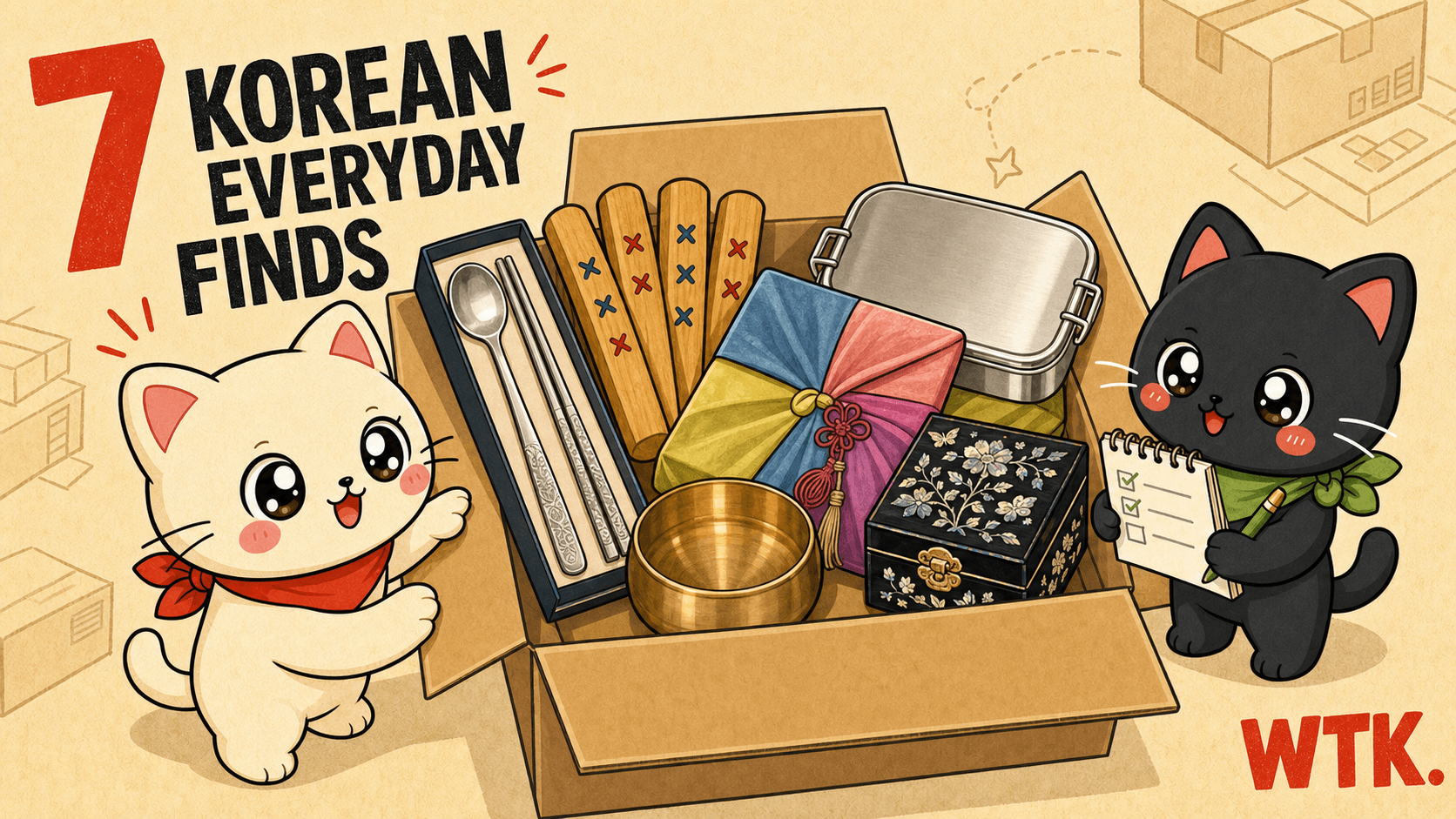
The most revealing Korean souvenirs are not always the ones displayed behind glass. They are the objects that sit beside a rice bowl, wrap a gift, travel to school, or come out when a family gathers for a holiday. This eBay shopping list recommends seven Korean everyday items with an actual use—and explains the listing details that matter before you buy.
This is not a live ranking of the cheapest listings. Prices, stock, shipping, seller claims, and import charges change constantly. Use the search links below to compare current offers, then judge the individual listing rather than treating “Korean” in a title as proof of origin.
The seven-item Korean culture shopping list
| Item | Search phrase | Best for | Check before buying |
|---|---|---|---|
| Stainless sujeo set | Korean stainless spoon chopsticks | Daily meals | Length, steel grade, country of manufacture |
| Yutnori set | Korean traditional yutnori set | Family game night | Four sticks, board or mat, tokens, rules |
| Old-school dosirak | Korean vintage lunch box | K-drama-style meals | Food-use material, lid fit, coating condition |
| Bojagi cloth | Korean bojagi wrapping cloth | Reusable gift wrapping | Dimensions, fabric, handmade versus printed |
| Korean stationery bundle | Korean stationery vintage stickers | Journaling and small gifts | Exact contents, official versus fan-made art |
| Najeonchilgi box | Korean mother of pearl jewelry box | Decorative storage | Inlay condition, hinges, interior, origin |
| Bangjja yugi bowl | Korean traditional brass bowl | Table setting | Alloy, weight, food-use claim, care needs |
If you want one low-risk starter order, choose the sujeo set. If you want the item that creates the best shared experience, choose yutnori. Collectors may find the dosirak or lacquer box more exciting, but condition and provenance matter much more for vintage pieces.
1. Sujeo: the object that changes a Korean meal
Sujeo (수저) combines sutgarak (숟가락, spoon) and jeotgarak (젓가락, chopsticks) into one word—and usually one matching set. The long-handled metal spoon is not an optional soup accessory. It handles rice, broth, stews, and mixed dishes, while chopsticks move the shared banchan (반찬, side dishes).
That pairing makes a stainless set a better introduction to Korean eating habits than a novelty cup or slogan T-shirt. The National Folk Museum of Korea notes that spoon use has been central to Korean dining for centuries and that metal remains a common material. Try the set with samgyeopsal and its table of side dishes or with bibimbap at home; the proportions immediately make more sense.
Look for a clear length measurement, smooth edges, and a stated stainless-steel grade. “Korean style” may mean only the shape. If manufacture in Korea matters, ask the seller for a photo of the box or stamped mark. Avoid badly pitted, bent, or unidentified vintage utensils for food use.
2. Yutnori: buy a game, not just a display object
Yutnori (윷놀이) is a race game in which players throw four wooden sticks and move tokens according to how the flat and rounded sides land. Families commonly play it around Seollal (설날, Lunar New Year) and other holiday gatherings. Korea designated the tradition a National Intangible Cultural Heritage in 2022.
A usable set should include four yutgarak (윷가락, throwing sticks), a board or cloth mat called a yutpan (윷판), and enough tokens for two teams. Printed English rules are convenient, but not essential; the basic rules are easy to find. Check the listing photos because some offers contain only miniature souvenir sticks or only the board.
This is the list's best social purchase. It turns Korean culture into an activity rather than shelf decoration, and imperfect throws create much of the fun.
3. The old-school dosirak seen in dramas
The rectangular metal dosirak-tong (도시락통, lunch-box container) recalls an era when school lunches were packed at home and metal boxes could be warmed near a stove. The nostalgic meal usually puts rice, kimchi, egg, and simple side dishes into one compartment; shaking the closed box mixes everything together.
Modern listings can be replicas, restaurant props, unused old stock, or genuinely used vintage containers. Those categories should not command the same price. For eating, buy a product explicitly sold as food-safe tableware and inspect the interior coating, rust, seams, and lid. A scratched mystery-metal box is better used as a photo prop or storage tin. It is also worth comparing a dosirak with the lightweight yellow yangeun pot: both turn humble aluminum objects into powerful nostalgia, but neither should be bought without checking its condition and intended use.
4. Bojagi: reusable wrapping that is also the gift
Bojagi (보자기) is a square wrapping cloth used to carry, cover, store, or present objects. A single cloth can wrap a box, bottle, book, or oddly shaped gift without tape. Patchwork versions called jogakbo (조각보) can also function as textile art.
Measure before buying: a photograph rarely communicates scale, and a 45-centimeter cloth has a different job from a 100-centimeter one. Also distinguish a pieced and sewn textile from fabric printed with a patchwork pattern. Neither is automatically bad, but “handmade jogakbo” should describe construction, not just appearance.
Choose washable fabric for repeated gift wrapping. Silk and ramie may be beautiful, but they require gentler care and are less forgiving for a beginner.
5. Korean stationery—without accidentally buying a bootleg
Korean stationery bundles can include letter paper, memo pads, sticker flakes, masking tape, pencil cases, and tiny planners. They suit buyers who enjoy the dense, playful visual language of Korean convenience stores and stationery shops but do not need a large or fragile object shipped internationally.
Read the itemized contents rather than buying from the first photo. Marketplace images sometimes show a styled collection even when the sale includes one randomly selected piece. For character goods, distinguish licensed products from fan-made or counterfeit items. Search a maker name printed on the packaging, compare logos and product codes, and be skeptical when a new “official” bundle costs far less than every comparable listing.
Vintage educational stamps, hangul stickers, and locally branded memo pads often tell a more specific Korean story than generic pastel stationery. If you collect K-pop paper goods instead, start with the separate guide to K-pop photocards and their collector vocabulary.
6. Najeonchilgi: when the box is the collectible
Najeonchilgi (나전칠기) refers to lacquerware decorated with mother-of-pearl inlay. Small jewelry boxes are common entry points: the shell catches light while floral, crane, landscape, or geometric motifs appear against a dark lacquer surface.
The broad term covers very different products, from Korean-made handwork to factory souvenirs and items merely described as “Asian.” Ask for photos of the base, interior, hinges, corners, and any label. Missing inlay, cloudy lacquer, odor, warped lids, and loose hardware affect value even when the front looks excellent. Do not pay a museum- piece premium without documented maker, age, origin, and condition.
A modest contemporary box with honest labeling is often a better purchase than a supposed antique supported only by adjectives.
7. Bangjja yugi: beautiful brass with a maintenance contract
Yugi (유기) is Korean brassware; bangjja yugi (방짜유기) specifically describes forged brass traditionally shaped through repeated hammering. Bowls, rice-bowl sets, spoons, and chopsticks create a warm gold table setting quite unlike everyday stainless steel.
This is the list's advanced purchase. Brass is heavier, tarnishes, and needs the care recommended by its maker. Listings may use “bangjja,” “yugi,” “bronze,” and “brass” loosely, so confirm the actual alloy, manufacturing method, weight, dimensions, and food-use status. Decorative antiques should not automatically become dinnerware.
If your goal is daily convenience, buy stainless sujeo. Choose yugi because you enjoy its weight, craft story, and maintenance—not because gold-colored tableware is inherently more authentic.
How to inspect an eBay listing before checkout
Use this five-minute check for every item on the list:
- Translate the title into facts. Identify maker, country, material, size, age, and condition. If the title supplies only adjectives, the listing is incomplete.
- Inspect every photo. Zoom in on bases, labels, corners, hinges, eating surfaces, and packaging. Stock photos cannot establish the condition of a used item.
- Read seller feedback in context. Check recent comments and sales of similar objects, not only the headline percentage.
- Calculate the delivered cost. Shipping, tax, duty, and import charges can turn a bargain into the most expensive option. eBay says international-shipping buyers may pay import charges at checkout or on arrival, depending on the transaction.
- Read the return terms before paying. Keep communication and payment on eBay; buyer protection depends on eligibility and the checkout process.
For cookware, tableware, cosmetics, food, or electrical goods, add destination-country rules and product safety to that list. This article recommends search categories, not the safety or authenticity of any individual seller's inventory.
What not to buy from a vague listing
Skip listings that hide the underside of an object, call every old item an “antique,” or mix “Korean,” “Korean style,” and “made in Korea” as if they were interchangeable. Do not buy consumables with unreadable dates, electrical products without voltage and plug specifications, or worn cookware without a clear material description.
The best Korean culture purchase does not need to be rare. It needs to be legible: you should know what it is, who made it, what it is made from, how you will use it, and what it costs at your door. A humble spoon set that joins dinner every night can carry more of Korea into your life than an expensive “traditional” object that never leaves its box.
Sources
- National Folk Museum of Korea: Encyclopedia entry on the Korean spoon
- Korea.net: Yutnori designated National Intangible Cultural Heritage
- Korea.net: The old-school Korean packed lunch and metal dosirak
- Korea Tourism Organization: Korea Must-Have Items shopping guide
- eBay: International purchases and shipping for buyers
- eBay: Money Back Guarantee policy