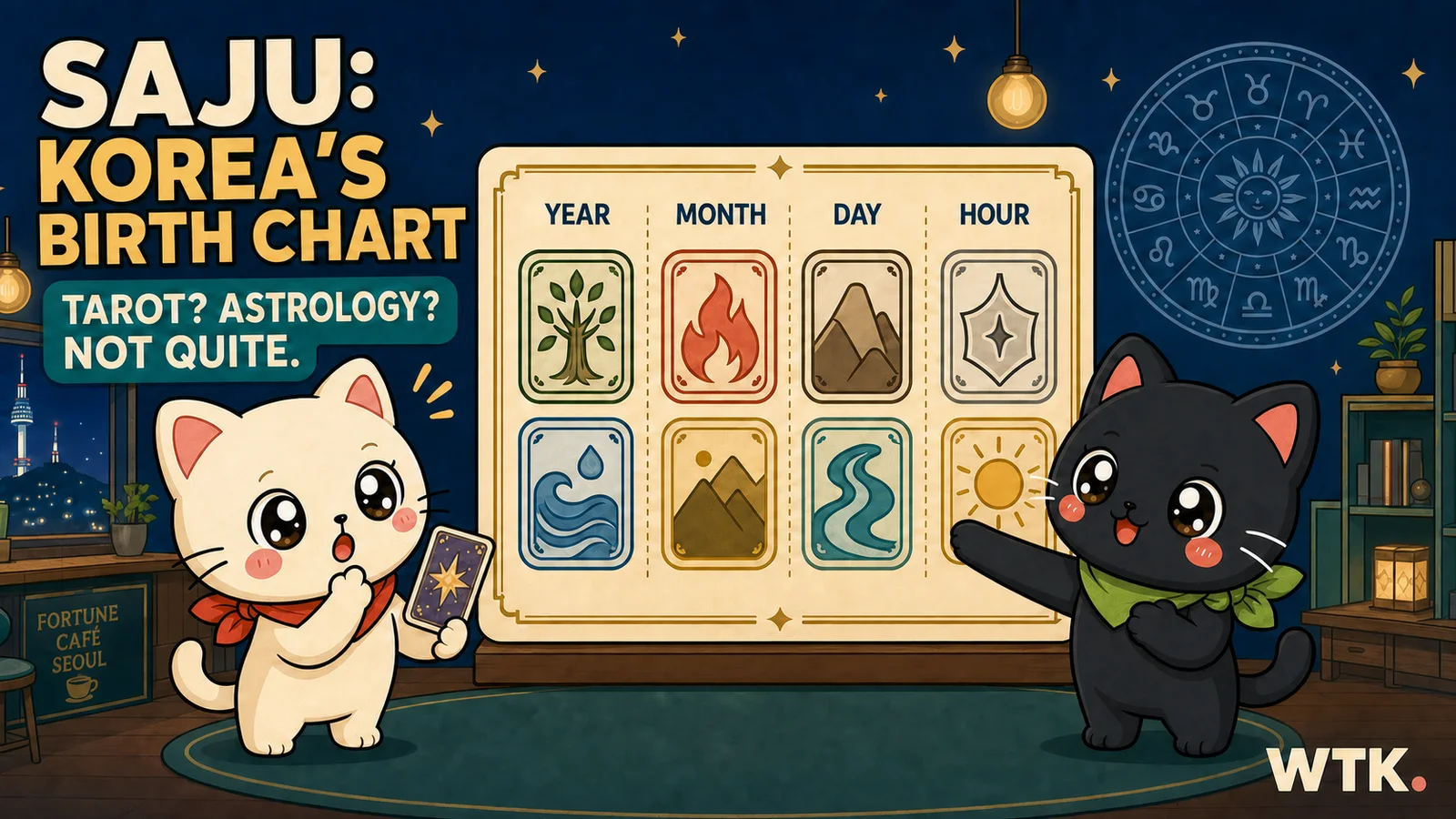
Imagine walking into a Seoul café and being asked for your birthday before anyone asks what you want to know. No cards are shuffled. No crystal ball appears. Instead, the reader turns your birth year, month, day, and hour into a small grid of Chinese characters.
That grid is saju (사주), Korea's familiar form of Four Pillars fortune reading. If tarot feels like a symbolic conversation with cards, and Western astrology feels like a map of the sky, saju feels like receiving the operating manual that supposedly came with the moment you were born.
The comparison is useful—but saju is not simply “Korean tarot” or “the Korean zodiac.” It uses a different calendar logic, a different symbolic vocabulary, and a distinctly Korean consultation culture.
What is saju palja?
The full expression is saju palja (사주팔자, 四柱八字), literally four pillars, eight characters.
The four pillars are:
- the year of birth
- the month of birth
- the day of birth
- the hour of birth
Each pillar contains two characters: one cheongan (천간, heavenly stem) and one jiji (지지, earthly branch). Four pairs produce eight characters, which explains palja—“eight characters.”
| Pillar | Starting information | What readers often associate with it |
|---|---|---|
| Year pillar | Birth year | Ancestry, early environment, wider social world |
| Month pillar | Birth month and seasonal point | Family structure, career setting, formative conditions |
| Day pillar | Birth day | The self and close partnership |
| Hour pillar | Birth hour | Later life, children, private ambitions, outcomes |
These associations are broad conventions, not a universal script. Schools and readers can emphasize different relationships.
A chart is calculated with the traditional stem-branch calendar, not by placing the four ordinary Gregorian numbers into boxes. The month pillar follows seasonal markers, and the hour is assigned to one of twelve traditional time blocks. Readers therefore use a manse-ryeok (만세력, calendrical chart or almanac), now often generated by an app.
The Academy of Korean Studies explains the name with a house metaphor: the year, month, day, and hour are the building's four pillars. Each receives a stem and branch, creating the eight-character structure.
Saju belongs to a wider East Asian Four Pillars tradition, often known internationally by the Chinese term Bazi. Calling it Korean does not mean Korea invented the entire system in isolation. It means Korea developed its own vocabulary, teachers, reading customs, cafés, apps, and everyday ways of using that shared tradition.
How a saju reader turns a birthday into a story
The visible chart is only the beginning. A reader examines relationships among eum-yang (음양, yin and yang) and the ohaeng (오행, five phases or elements):
- mok (목, wood)
- hwa (화, fire)
- to (토, earth)
- geum (금, metal)
- su (수, water)
“Element” is the familiar translation, but these are better understood as interacting qualities and processes than five physical ingredients hidden inside a person. Wood can feed fire; fire can produce earth; other relationships control, weaken, support, or clash. The reader looks for patterns of balance rather than simply counting which color appears most.
The day stem, often called the Day Master, becomes an important reference point for interpreting the rest of the chart. Readers may then discuss personality, work, relationships, money, health themes, or changing periods such as daeun (대운, large fortune cycles) and seun (세운, annual fortune).
This explains a common Korean sentence:
Saju boreo ganda (사주 보러 간다) — “I'm going to have my saju read.”
The verb boda means “to see.” You do not usually say you are taking a saju test. The chart is treated as something to inspect and interpret with another person.
The same base data should produce the same basic eight characters under the same calculation rules, but readings can still sound very different. One reader may focus on career timing, another on elemental balance, and another on the client's current problem. Interpretation, school, calendar convention, and 상담 style all matter.
Saju vs. tarot vs. Western astrology
All three systems can become languages for talking about personality, timing, fear, and choice. Their engines, however, are not interchangeable.
| Question | Korean saju | Western astrology | Tarot |
|---|---|---|---|
| Main input | Birth year, month, day, and hour | Birth date, exact time, and place | A question or present situation plus drawn cards |
| Core symbols | Stems, branches, yin-yang, five elements | Sun, Moon, planets, zodiac signs, houses, aspects | Usually a 78-card deck, positions, images, and spread |
| Base chart | Fixed from birth data | Fixed natal chart from birth data | New cards can be drawn each session |
| Typical visual | Eight Chinese characters in four columns | Circular horoscope wheel | Cards arranged in a spread |
| Typical emphasis | Inborn pattern, balance, relationships, life cycles | Personality, drives, life areas, planetary timing | Present dynamics, choices, feelings, possible directions |
| Short version people know | Birth-year animal or “my element” | Sun sign | A single card pull |
| What the full system adds | Day Master, seasonal strength, element relations, timing cycles | Moon, rising sign, houses, aspects, transits | Card position, surrounding cards, reversals, reader dialogue |
Saju and astrology are cousins, not translations
Saju and natal astrology have the strongest structural resemblance because both begin with the moment of birth. Give the same birth information again and the underlying chart does not randomly change.
Western astrology maps the apparent positions of the Sun, Moon, and planets through zodiac signs and houses, then interprets angles called aspects. Saju converts time into stems and branches and interprets seasonal strength, yin-yang, and five-element relationships.
That means “I am a Leo” does not translate into one saju character. Likewise, saying someone has “strong fire” in saju does not automatically mean they are a Western fire sign. The two systems can produce similar-sounding personality language while arriving there through different symbolic maps.
Tarot begins with the question, not the birthday
Tarot is more flexible about birth data because the reading centers on cards drawn for the present question. A person might ask, “What am I missing in this relationship?” and read the images as a prompt for reflection. Ask again later and a different spread may create a different conversation.
Historically, tarot was not born as an ancient fortune system. The Metropolitan Museum of Art traces early tarot to fifteenth-century European card games and notes that its occult and fortune-telling association became widespread much later.
This makes tarot especially good at dramatizing an immediate crossroads. Saju more often presents the crossroads as one chapter inside a larger life pattern. In practice, Korean fortune cafés may offer both. A client can receive a broad saju overview and then use tarot for one sharply framed question.
Why saju still feels modern in Korea
Saju can sound ancient on paper, yet its current setting may be a phone screen, a café, a pop-up event, or a ten-minute consultation between shopping appointments.
In 2026, Seoul hosted a large “fate expo” where young visitors queued for saju, tarot, face reading, career-themed sessions, and five-element accessories. The event's rules are revealing: organizers prohibited fear-based claims, medical, legal, and financial counseling, hard sales of amulets, and shamanic spirit readings.
That separation matters. Saju is not automatically shamanism. A mudang (무당, Korean ritual specialist) may offer divination, but a saju reader can calculate and interpret birth charts without claiming contact with a deity or spirit. Our guide to ghosts, mudang, and shamanic rites in K-dramas explains that different tradition.
For many Koreans, having one's saju read is not a declaration of total belief. It can be entertainment, a New Year ritual, a conversation starter, or a way to organize anxiety into questions. A skeptical friend may laugh at the result and remember the most accurate sentence for years.
The most common topics are extremely ordinary:
- sinyeon unse (신년운세): fortune for the new year
- gunghap (궁합): compatibility between two people
- chwieop-un (취업운): job-seeking prospects
- jaemul-un (재물운): money or wealth prospects
- yeonae-un (연애운): romance prospects
- idong-su (이동수): likelihood of moving, traveling, or changing position
This is why saju fits contemporary Korean life so neatly. Uncertain career ladders, housing decisions, marriage timing, and job changes already feel like invisible systems. A chart promises to make those systems visible, even if only for the length of a conversation. If your reading suddenly fills with corporate ranks, our guide to Korean office titles such as bujang will decode the workplace vocabulary.
Relationship questions are equally popular. Gunghap can mean comparing two charts for romantic or marital compatibility. It is more elaborate than asking whether two zodiac Sun signs match. It also helps explain why Korean dating content can turn labels into entire social stories, as in the term motae solo, meaning single since birth.
How foreigners can try a saju reading
A good first reading does not require you to believe that eight characters control your life. Treat it as a guided encounter with a Korean interpretive tradition.
Bring:
- your birth date
- your birth time as accurately as possible
- your birthplace and original local time zone
- two or three questions you actually care about
- confirmation of whether your date is recorded in the solar or lunar calendar
Do not casually convert your own overseas birthday into Korean time before the session. Practitioners differ on time-zone, daylight-saving, solar-time, and Southern Hemisphere questions. Give the original facts and ask the reader to explain the method used.
Useful phrases include:
| Korean | Romanization | Meaning |
|---|---|---|
| 사주 보고 싶어요 | Saju bogo sipeoyo | I would like a saju reading |
| 태어난 시간을 몰라요 | Taeeonan siganeul mollayo | I don't know my birth time |
| 직업운이 궁금해요 | Jigeop-uni gunggeumhaeyo | I'm curious about my career fortune |
| 연애운이 궁금해요 | Yeonae-uni gunggeumhaeyo | I'm curious about my love fortune |
| 궁합도 볼 수 있어요? | Gunghapdo bol su isseoyo? | Can you also read compatibility? |
Before sitting down, confirm the price, duration, language, and whether translation is available. A responsible reader should be able to describe limits without frightening you. Leave if someone predicts catastrophe, demands an expensive ritual, or pressures you to buy a cure.
Most importantly, do not use saju, tarot, or astrology as a substitute for qualified medical, legal, mental-health, or financial advice. None is scientifically established as a way to predict events or diagnose a person. Their cultural and reflective value does not require treating every statement as fact.
The easiest way to remember the difference
Think of three tables.
At the first, a saju reader places your birth time into a four-column calendar. At the second, an astrologer places your birth time onto a map of the sky. At the third, a tarot reader places your present question among drawn images.
Saju asks how the pattern you were born with moves through changing cycles. Astrology asks how celestial positions and their relationships describe a life. Tarot asks what the cards make visible about this moment.
They can all become mirrors. They are simply mirrors built with different geometry. And in Korea, the four-column mirror remains surprisingly at home beside smartphones, café drinks, career anxiety, dating shows, and the annual question everyone eventually asks: “So—what does next year look like for me?”
Sources
- Academy of Korean Studies — Saju (Korean)
- Korea Tourism Organization — K-Fortune Saju experience
- The Korea Times — Gen Z flock to Korea's first fate expo
- Korea JoongAng Daily — Young Koreans seek bite-sized bits of luck online
- The Metropolitan Museum of Art — Before Fortune-Telling: The History and Structure of Tarot Cards
- Encyclopaedia Britannica — Astrology