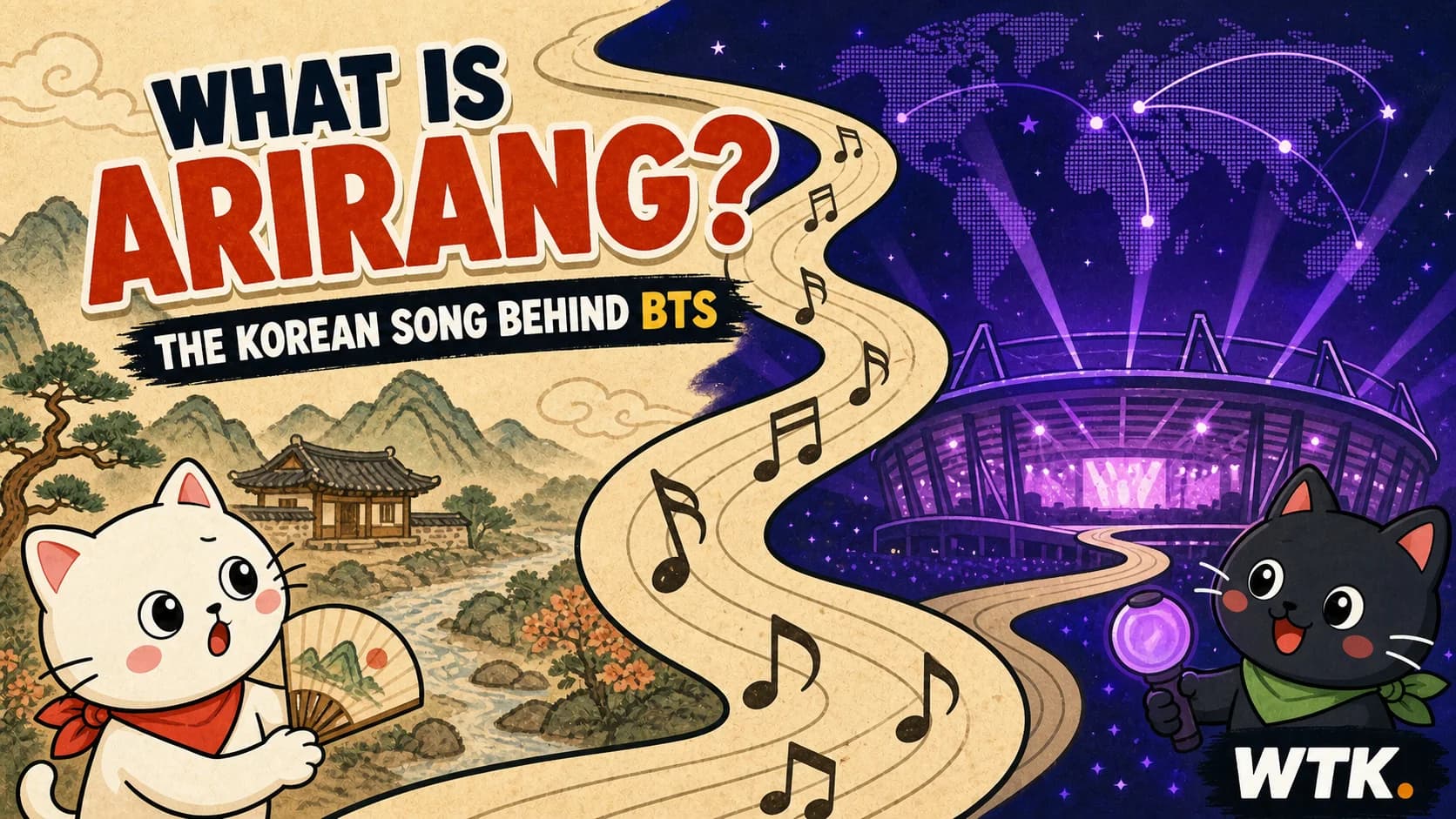
As BTS carries its ARIRANG world tour through stadiums far beyond Korea, one Korean
word is appearing on tickets, screens, and fan banners around the world. It is not a new
piece of fandom vocabulary. Arirang (아리랑) is the name of Korea's best-known folk
song tradition—older, larger, and harder to translate than one famous melody.
BIGHIT MUSIC has connected the title to BTS's Korean origins, identity, longing, and deep love. To understand why that word can carry a global comeback, however, you first have to forget the idea that Arirang is simply one old song.
Arirang is not just one song
Most newcomers hear the familiar refrain—Arirang, arirang, arariyo—and assume there must be one official set of lyrics. There is not.
Arirang is better understood as a family of Korean folk songs. Communities reused a recognizable refrain while changing the melody, rhythm, verses, and mood to fit their own region and lives. New words could be improvised for work, love, separation, hardship, satire, or celebration.
UNESCO cites expert estimates of approximately 60 versions and 3,600 variations. That scale changes the question. Instead of asking “Which recording is the original?” it is often more useful to ask “Whose Arirang am I hearing?”
Four names offer a practical starting map:
| Version | Region or association | First-listen character |
|---|---|---|
| Bonjo Arirang | Seoul/Gyeonggi; widely recognized modern standard | Lyrical, balanced, and immediately familiar |
| Jeongseon Arirang | Jeongseon, Gangwon Province | Long, flexible, and narrative-driven |
| Jindo Arirang | Jindo, South Jeolla Province | Strong rhythmic lift and communal energy |
| Miryang Arirang | Miryang, South Gyeongsang Province | Fast, bright, and lively |
These labels simplify living traditions, but they reveal the essential point: Arirang can sound like private sorrow in one performance and a festival in another without ceasing to be Arirang.
What does the word “Arirang” mean?
There is no universally accepted etymology. Many theories try to break Arirang into older words or connect it to legends, place names, love, beauty, or emotional pain. None has become a final scholarly answer.
That uncertainty is not a defect. The refrain works partly because singers do not need one literal definition before making it their own. Across different lyrics, Arirang often gathers a recognizable field of emotion:
- separation from someone loved
- longing for a person or home
- crossing a difficult pass or continuing a journey
- resentment toward someone who leaves
- endurance through hardship
- reunion and the hope of return
The frequently imagined Arirang gogae (아리랑 고개, Arirang Pass) may sound like one specific mountain location, but it often functions poetically: a threshold that someone must cross, a distance between people, or the hard part of a journey.
This is why translating Arirang as only “a sad song” misses half of it. The sadness moves. Someone leaves, someone continues walking, and a community keeps singing.
Why Koreans can share a song with no fixed lyrics
Arirang grew through participation rather than ownership by one composer. Its simple refrain made it possible for people to join before learning every verse. A lead singer could offer new lines, and others could answer with the part everyone knew.
UNESCO emphasizes creativity, freedom of expression, empathy, and group singing when describing the tradition. Those features explain how Arirang survived changing media and history. It can be sung alone without losing intimacy, arranged for an orchestra without losing its refrain, or transformed on a pop stage without becoming a museum replica.
The song also travels unusually well. Korean communities abroad have used Arirang to express memory and belonging when separated from the peninsula. Within Korea, regional versions preserve local speech, musical character, and stories. The shared word does not erase those differences; it gives them a place to meet.
Arirang across one divided peninsula
Calling Arirang simply a South Korean national song is incomplete. It is recognized across the Korean Peninsula and among overseas Korean communities.
UNESCO inscribed “Arirang, lyrical folk song in the Republic of Korea” on its Representative List of the Intangible Cultural Heritage of Humanity in 2012. In 2014, it separately inscribed “Arirang folk song in the Democratic People's Republic of Korea.”
The separate listings reflect two states and two heritage nominations. The underlying tradition reaches beyond that political division. Arirang has repeatedly appeared when Koreans needed music recognizable on both sides, making it an especially powerful symbol of shared culture without pretending that division has disappeared.
It is sometimes described as Korea's unofficial national anthem. That phrase captures its familiarity but not its structure: a national anthem normally has authorized words and music; Arirang remains powerful precisely because people keep changing it.
Why BTS chose ARIRANG
The verified facts come first. BTS released its fifth album ARIRANG on March 20,
2026, followed by a world tour carrying the same name. BIGHIT MUSIC described the album
as embodying BTS's identity as a group that began in Korea and the longing and deep love
within the members' story. HYBE also described it as representing the group's origin,
identity, and present message.
That makes the Korean folk tradition relevant rather than decorative. Arirang offers a language for roots that is not frozen in the past and for longing that can be sung collectively.
Several connections are reasonable cultural readings:
- Rooted in Korea, heard globally. A local folk refrain has always changed as it traveled; BTS built a global career without hiding its Korean starting point.
- Separation and return. Arirang often voices distance, waiting, and reunion—emotions that resonate with a full-group return after years of separate activity.
- One refrain, many voices. Arirang belongs to collective variation, while BTS's identity combines seven distinct performers and a worldwide audience.
- Tradition as a living form. Naming a contemporary album and stadium tour
ARIRANGplaces heritage in current popular culture instead of behind glass.
These are interpretations of the cultural relationship, not claims that every old Arirang lyric predicts BTS's biography. Where the members or label have not stated a specific symbolic connection, it should remain an informed reading rather than an official explanation.
From folk refrain to stadium chorus
The tour setting adds another layer. Arirang historically invites people to answer a refrain together. A stadium concert also turns individual listeners into a temporary singing community—though amplified by screens, choreography, and synchronized lightsticks.
That does not make a K-pop concert equivalent to a village folk performance. It does show why the name can work at stadium scale. The word already contains a tension BTS has navigated for years: intensely Korean references that become points of connection for people who did not grow up in Korea.
Fans trying to attend that stadium experience face a much newer Korean ritual: competitive online ticketing. Our guide to why K-pop tickets sell out in seconds explains fan-club presales, queues, cancellation tickets, and the macro problem.
The same tour also creates a different kind of curiosity outside the stadium. Our analysis of BTS concert dates and HYBE stock shows why a sold-out show can support company revenue while the share price still falls.
How to hear Arirang for the first time
Do not look for one definitive recording. Try contrasting versions in this order:
- Bonjo Arirang — begin with the melody most international listeners recognize.
- Jeongseon Arirang — listen for extended storytelling and flexible pacing.
- Jindo Arirang — notice how the refrain can carry force and rhythmic excitement.
- Miryang Arirang — hear how bright and animated the same tradition can become.
- A contemporary arrangement — compare an orchestral, rock, gugak, or pop version and ask what changed besides the instruments.
Listen for the response pattern, repeated refrain, and movement between individual verses and collective return. You do not need to understand every Korean word to hear the structure of leaving and coming back.
That journey from traditional culture into modern fandom is becoming a recognizable WTK theme. RM's interest in the Joseon painter Kim Hong-do creates a similar bridge; our guide to the artist behind the RM museum story explains why ordinary scenes painted centuries ago feel newly visible through K-pop.
More than background music for a comeback
The easiest explanation is that Arirang is Korea's most famous folk song. The better explanation is that it is a method Koreans have used to keep rewriting separation, home, hardship, affection, and belonging in a form other people can join.
That is why thousands of versions do not weaken its identity. They are its identity.
And it is why ARIRANG can name both a song tradition carried across generations and a
BTS tour carried across continents: the point is not to repeat one version perfectly.
The point is to take the refrain somewhere new and still find a way home.
Sources
- UNESCO: Arirang, Lyrical Folk Song in the Republic of Korea
- UNESCO: Arirang Folk Song in the Democratic People's Republic of Korea
- Weverse: BTS The 5th Album ARIRANG Pre-Order Notice
- BIGHIT MUSIC: BTS ARIRANG World Tour
- Yonhap: BTS Redefines Koreanness in ARIRANG
- Korea.net: Miryang Arirang and Korea's Major Regional Versions
- Korea.net: Jindo Arirang and the Uncertain Meaning of the Name